
If you want to protect the walls of your chest freezer from rust and corrosion, but don’t want the hassle, difficulty, or look of a basic pond liner or the expense of a professionally sprayed product, then a custom liner is a great option to consider.


Standard pond liners are inexpensive, but there are a few problems:
- They can be difficult to install correctly
- It is difficult to get them to stay in place
- It can take a long time and be frustrating to install and remove them
- Using tape or Velcro to hold them in place can leave residue and make them harder to remove when they need to be cleaned
- They can be hard to remove and clean
- They take up room in your chest freezer
- They make it difficult for your lid to close or seal all the way – which can increase your power bill
- They don’t look great
- They might leach toxic chemicals into your water unless they are certified safe for fish and aquatic life
- The dark color makes it harder to see when your water gets dirty and needs to be cleaned
- Thin liners can easily rip or tear
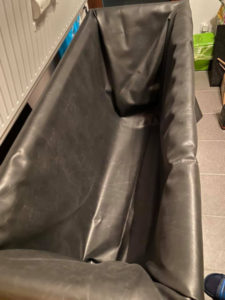
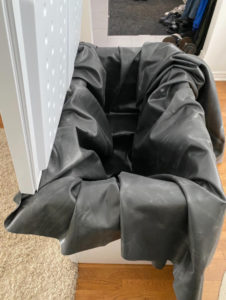
Here are a few pictures of standard rectangular pond liners.

Here is information about the liners that I offer:
- Easy to install
- Stay in place without any kind of tape, velcro or fastener needed
- Can be installed and removed in minutes
- Easy to clean
- Look great
- A loose-glove fit keeps plenty of room in your chest freezer
- Make your cold plunge feel inviting to get into
- Allows your chest freezer lid to close and seal easily
- Look great
- Pool and spa-grade PVC is VOC-free and safe for human use
- The white color makes it easy to see the quality of your water
- Easy to clean
- Durable 20 mils PVC
The material is a flexible and durable pool and spa-grade white PVC.
The liner’s seams have a 1-year manufacturer’s warranty. Mine is over 4 years old, has been used with daily ozone, and is still working fine.
It will be custom-made to the measurements that you will provide. You will be given a link to download a measurements form to fill out, along with directions.
Pricing
See the product page linked below for pricing. Shipping in the lower 48 states is included. If you live in Hawaii, Alaska, or any country outside of the US, please contact me for a shipping quote. Shipments to Europe have been around $250-$350 + customs and duties fees, which you must pay locally.
Where do you ship?
We ship globally.
Production Time
All of the liners are made in the USA. See the link below for production lead times.
How to Purchase
Select the size of your liner based on your chest freezer volume. Add the liner to your cart. You will be sent an email with directions on how to download the measurements form and instructions. After you return your form, we will send your measurements to the production team, who will then put your liner into the production queue.
The liner is non-refundable. There are no cancellations. Only order this product if you already know that you want it.
To order your custom liner order, click this link:
https://chestfreezercoldplunge.com/product/custom-liner
FAQ
How does the liner stay in place?
The liner will overhang all four outer walls of your chest freezer to keep it in place all on its own. No tape, Velcro, magnets, straps, etc., will be necessary.
How does the liner fit around the hinges or lock on the front?
The production team does not make cutouts for the lock /handle on the front or the hinges on the back. They are easy to make with standard office scissors or a box cutter and ruler if you want cutouts. Some people remove the lid, install the liner, and put the lid back on over it. The lid will have to be removed when you pull out the liner to clean it. Some people make cutouts for the hinges but not the lock/handle. You can set it up in whatever way you prefer.
Is there an odor to the PVC?
Yes, the liner may have a slight odor from the manufacturing process. This will dissipate with time, however, can be reduced by leaving it in the direct sun for a few days, cleaning it with a 50/50 white vinegar/water solution, or scrubbing it with a baking soda/water paste.
Do I still need to seal the seams on my chest freezer?
Yes, it is still a best practice to seal the seams of your chest freezer. Even chest freezers used for their intended purpose develop rust over time, and it is possible for condensation to build up between the liner and chest freezer walls/floor.
Do I have to use JB Water Weld (or another 2-part epoxy putty)?
While 2-part epoxy putty is the most reliable way to seal the seams, some people do not want the time, effort, and expense involved.
Because the liner will prevent water from directly contacting the chest freezer and seams, you can use high-quality silicone to seal the seams. All interior seams should be sealed, including the top upper seam where the walls meet the plastic trim.
Does the liner prevent the lid from closing or sealing?
Since 2018, there have only been two reports of the lid not closing after the liner was installed. In both cases, a hair dryer or heat gun was used to heat up the liner material to help it lay down flat. The lid was closed, and a heavy weight was placed on top of it.
Can I still place cords, wires, or tubes between the liner and the gasket?
Yes.
Does the liner interfere with or prevent the chest freezer from cooling the water?
No. PVC has no insulative properties, and your chest freezer will work the same as without the liner.
How do I clean the liner?
The liner should be removed periodically (as needed) for cleaning, and to inspect your chest freezer to ensure that moisture is not building up between the walls and liner. I usually remove mine once every 6 – 12 months.
What if the seams break?
The liner is assembled into one piece using a radio-electric welding process that binds the material together at a molecular level. The seams are stronger than the original material and are covered by a 1-year warranty. I have used mine since 2018, and it is still in great shape.
Does the material stretch?
The material is a very slight stretch to it.
What if I measure incorrectly?
The measurements are easy to take, and we encourage you to double-check them. I look over each one to ensure they are close to similar chest freezers. However, I am unfamiliar with all chest freezers and provide this as a courtesy, not as any guarantee. Incorrect measurements are not covered under warranty, and you will need to pay for the liner to be adjusted and shipped both ways.
Will the liner material be damaged by ozone, chlorine, H2O2, salts, etc.?
No. This PVC material is rated for use in swimming pools and spas and is fine with any of the above sanitation methods. I’ve used ozone with mine daily since 2017.
Are any other colors available besides white?
Not at this time.
How do I clean the liner?
While it is in the tub filled with water, you can use a microfiber cleaning cloth to wipe it down. Just like on your chest freezer walls, it is possible for algae to build up on the liner, For annual cleaning, use mild dish soap, baking soda, 3% H2O2, a 50%/50% white vinegar/water solution, or a mild cleaner of your choice.
What about phthalates?
I looked into this before I offered the custom liners for sale.
Studies show that phthalates can cause health problems. However, it’s important to distinguish which phthalates (there are six), from what sources, and by what exposure method.
The biggest concern with phthalates is when they are ingested (from exposure through food containers or packaging), inhaled (by workers in manufacturing facilities), and from use in children’s toys that could be chewed on. Phthalates for use in children’s toys were banned in the US in 2009.
Some of the information comes from animal studies using chronic ingested exposure – meaning that rats were fed high concentrations of phthalates over long periods – that do not translate to human exposure.
Dermal exposure from the phthalate DBP, used in cosmetics (perfume, hair gels, body lotion, shampoo, deodorants, nail polish, etc.) is a cause for concern.
DEHP is the most widely used phthalate and is used mainly as a plasticizer in polyvinyl chloride (PVC) products because of its low cost.
Some leaching out can occur, especially by heat or solvents.
It seems that the biggest concern is the lower-molecular-weight phthalates, which is why some manufacturers are replacing them with high molecular-weight phthalates, which include DINP and DIDP.
The plasticizer used in our custom liners is DINP.
DINP has very low solubility in water because of its high molecular weight, and if any leaches into the water, it ends up as sediment. Further, it rapidly biodegrades in water, and 68% is removed within one day, and 90-100% is removed within 5 to 28 days.
The 2022 classification by the European Chemicals Agency lists DINP as “Not classified but some uses restricted.” DIDP is not classified. Neither of these is listed as being toxic to reproduction, endocrine disrupting, or skin sensitizing.
The company that supplies the material used for the custom liners submitted a “Request for Risk Evaluation” to the EPA in 2019. The custom liners fall under the category of pool liners.
Research cited in the evaluation request shows dermal absorption of DINP is low. Other research that I read stated that various phthalates have different absorption rates through the skin. All studies that I found only looked at dermal absorption at room temperature. In cold water, skin pores contract and close, which further reduces the likelihood of absorption.
According to the EPA’s 2012 Phthalates Action Plan DINP exhibits low toxicity to aquatic organisms and is ranked low for persistence and bioaccumulation.
Furthermore, chlorine, H2O2, and ozone all oxidize DINP, so if you use any of these sanitation methods, the already low risk is reduced exponentially. And, as mentioned, particulates will get caught in the filter.
Our custom liners PVC material has been certified for use in pools and spas. We could use PVC certified for potable water systems, but it would increase the price by nearly 30%. However, based on all of the information I have, there does not seem to be a good reason to do that since, hopefully, you are not drinking the water in your cold plunge.
The EPA’s response to the evaluation states that based on their testing, the hazard level of DINP in flexible PVC applications is very low.
Based on what I’ve learned about it so far, I believe it is safe to use these custom liners. I have been using mine since 2017 – with the JED ozone generator- and have not seen any side effects. Of course, I am a sample size of one (not statistically valid), everybody is different, and each person has their own level of risk tolerance. .
Let me know if you have any questions about measuring or how else I can help.