
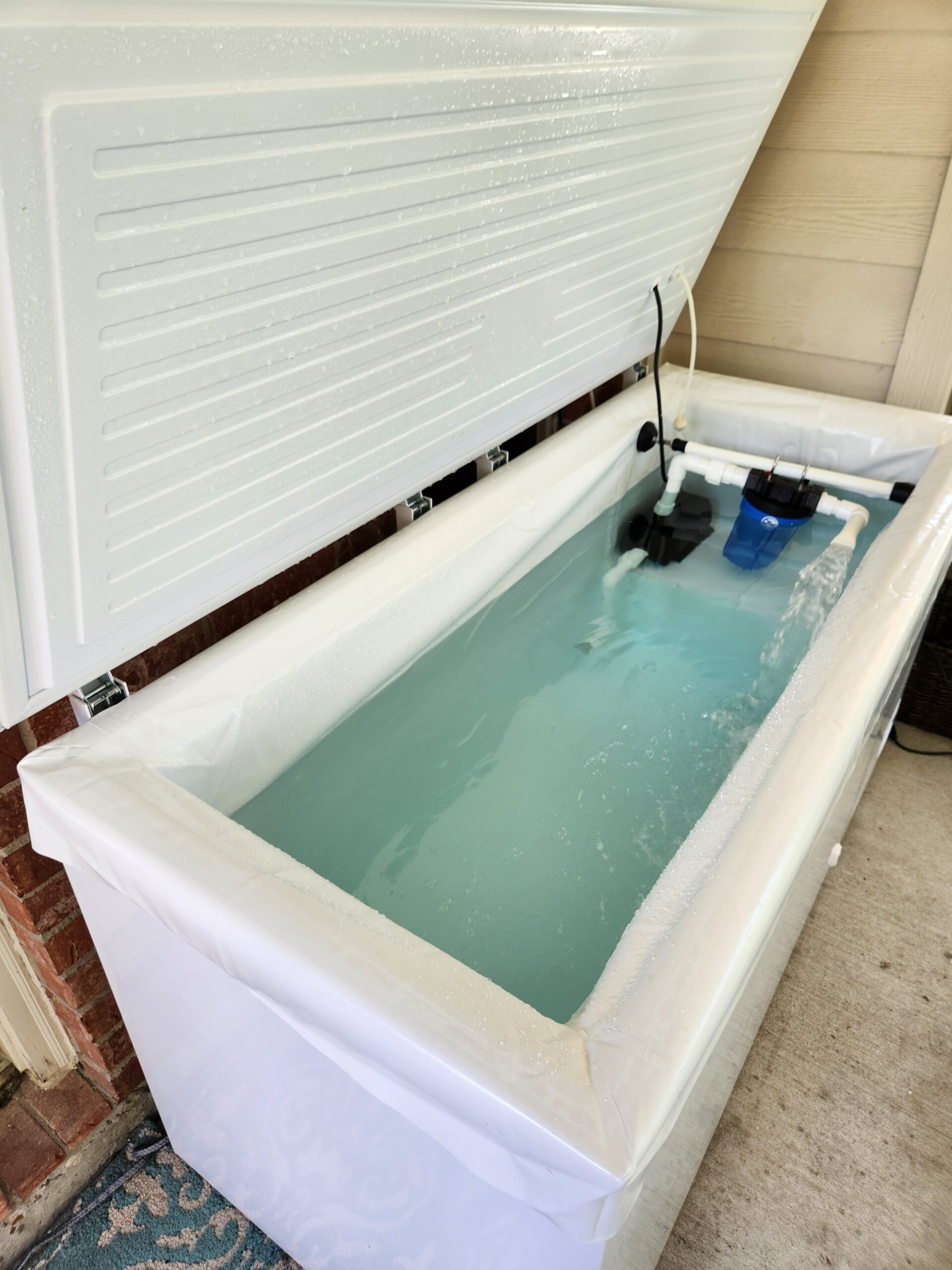
Custom Liner
Price range: $599.00 through $899.00
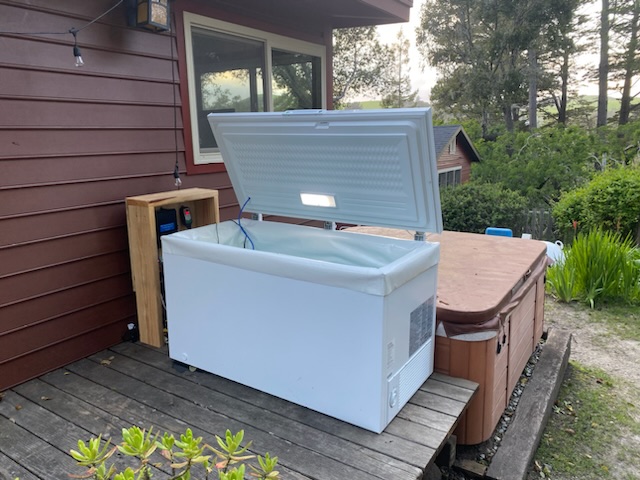
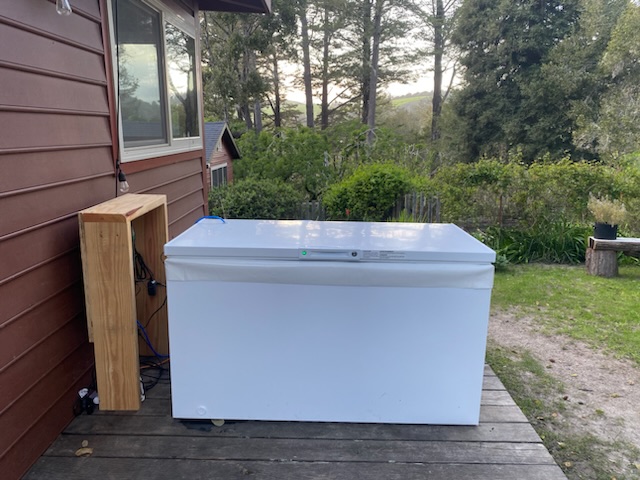
Since years of testing every waterproofing option available since 2017, this is the one I built for myself and still stand behind. Custom made to your freezer’s measurements from 20-mil pool and spa-grade PVC with RF-welded seams. Removable, durable, and in use by 200+ cold plungers worldwide.
Description
Custom Waterproof Liner for Chest Freezer Cold Plunges
The liner I wish had existed when I started.
I built my first chest freezer cold plunge in 2017. Not because I wanted to, but because I had to. What followed was a series of waterproofing disasters- rust, toxic fumes, weeks of stripping enamel, and a professional epoxy coating my ozone generator destroyed within days. The full story is on the About page. The short version: I tried a lot of things before I built something that actually worked.
This liner is what I built. It has been in continuous use by real people, in real chest freezers, in real climates, for years. If you’re here because you’ve done your homework and want to skip the part where things go wrong, you’re in the right place. And if you’ve already been through some of the alternatives, I understand that too.
Why most people end up here
Whether you’re building your first cold plunge or you’ve already fought with another waterproofing method, it helps to see the full picture before you spend any money.
Here’s an honest look at the most common options:
Basic pond liner ($60-$120)
- Cheapest upfront option and installs in 30 minutes
- Typically develops pinhole leaks within 4-6 months
- Requires frequent inspection and regular replacement
- After 2-3 replacement cycles you’ve spent $180-$360, with hidden corrosion risk the entire time
- Best for people who need a short-term solution right now and understand what they’re getting into
Pond Shield and 2-part epoxies ($300-$500)
- Can work well when every best practice is followed without exception
- Multi-day application process with many steps, each a potential failure point
- Based on what I see reported in my 56,000-member Facebook community, troubleshooting posts for 2-part epoxy coatings outnumber any other waterproofing issue by a significant margin
- I believe most Pond Shield failures are user error, not product failure- but user error still means your freezer is at risk
- Repairs are often as complicated as the original application
Line-X XS-350 ($600-$1,500)
- A legitimate long-term option when done correctly by an experienced shop
- Cost varies significantly depending on the shop and their schedule
- Reliability drops sharply when XS-100 or off-brand knockoffs are used instead of XS-350
- No application process for you to get wrong, but shop quality matters enormously
Custom liner ($599-$899)
- More upfront than a pond liner, less than a professional Line-X job
- No multi-day application process, no shop dependency, no chemical compatibility concerns
- Made from durable 20-mil pool and spa-grade PVC with RF-welded seams
- 7+ year demonstrated track record in daily use
- Removable for cleaning and inspection
- Measure, order, drop it in
For a full side-by-side breakdown of every removable liner option including DIY form-fitted liners and stock liners, see my Removable Liners Guide.
What this liner is made of
The liner is made from durable 20-mil pool and spa-grade white PVC. This is the same type of material used in above-ground pool liners that hold thousands of gallons of water. It is not a thin sheet. It is not a generic pond liner. It is purpose-built for long-term water contact from material designed to live submerged.
The seams are RF welded- not glued, not taped, not hand heat-welded.
This matters because the seam is where liners fail. Adhesive-based seams break down under sustained cold water exposure. Hand heat-welding requires exact temperature control that is nearly impossible to achieve consistently without professional equipment. RF welding uses radio-frequency energy to bond the PVC at a molecular level, creating seams as strong as the material itself. The machine used to make these liners costs $50,000. It is not a DIY tool, and it is one of the main reasons this liner performs the way it does.
The white color is intentional. It makes your water condition easy to see at a glance.
“The custom liner is the best investment anyone can make when setting up a freezer as a cold plunge. While that initial cost is expensive, the time and headaches you save make it well worth it. I’m over a year in with my liner and haven’t had any issues.”
– Chris Dreisbach
How it fits- read this before you order
I’m going to explain this once, clearly, because it is the most important thing to understand before you buy.
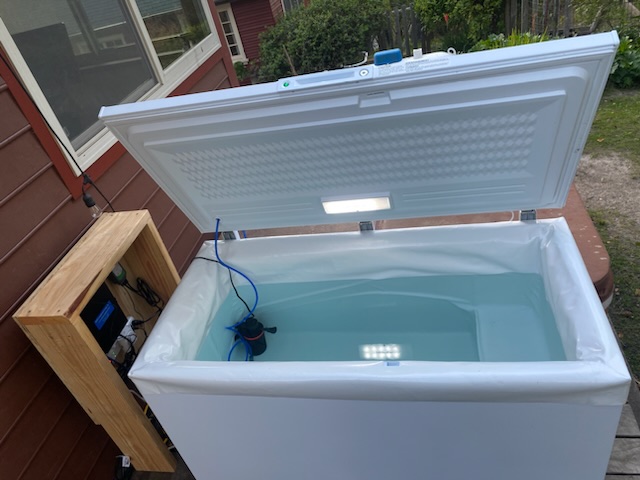
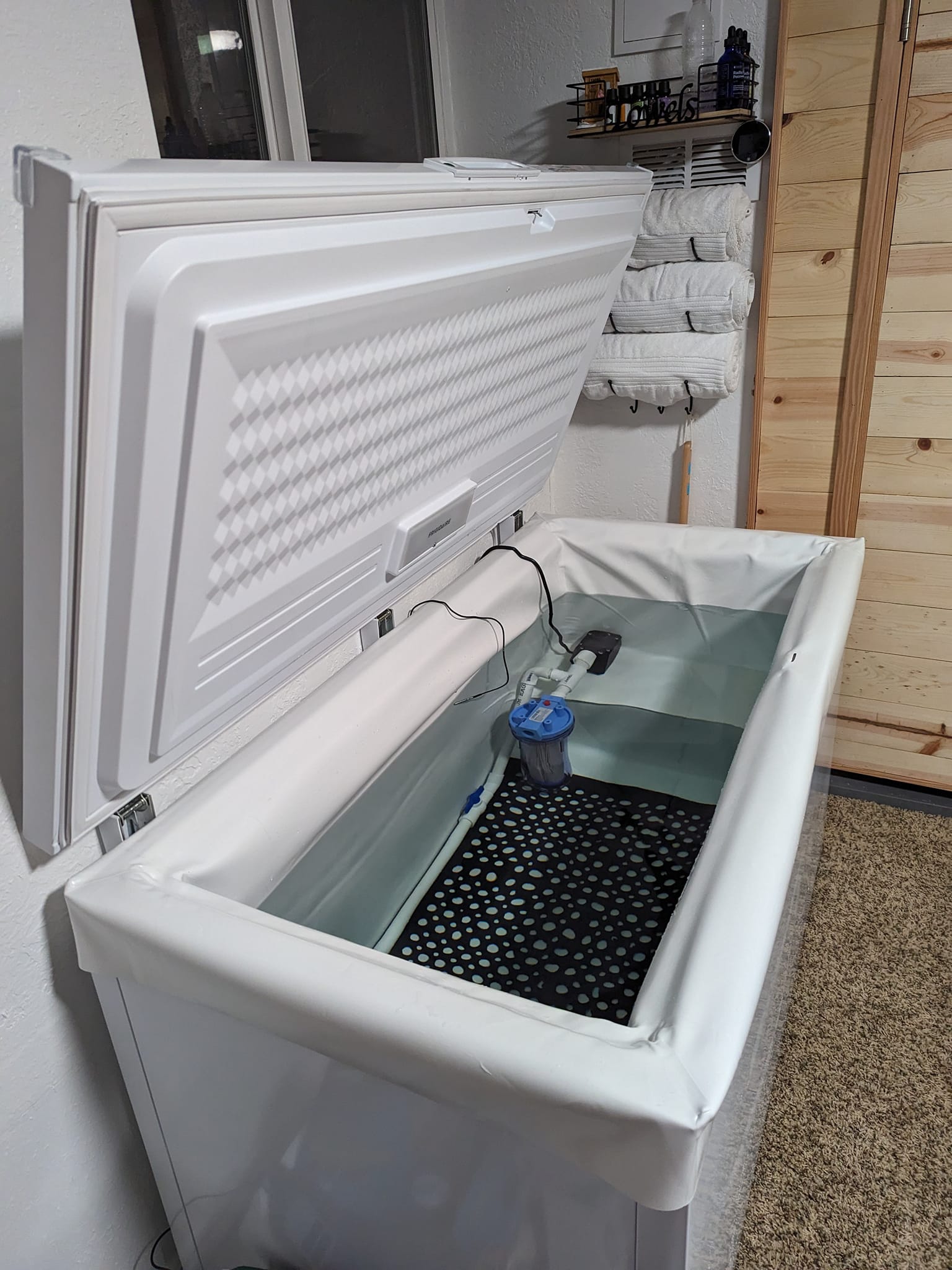
The liner is designed to fit like a loose glove. It is not a rigid molded insert.
Chest freezers are not precision-manufactured boxes. The inner walls bow, taper, and vary because of the way foam insulation is injected between the inner and outer walls. No two freezers are exactly the same inside, even within the same model. The liner is made with enough flexibility to work with these real-world variations.
When you first install it, before filling with water, you will likely see soft folds, minor wrinkles, slight sagging in some areas, rounded corners, small air gaps behind the liner, and extra material in certain spots.
These are normal. They are not defects. They do not affect waterproofing or the cooling efficiency of your freezer.
Once you fill the freezer with water, the weight of the water helps the liner settle into place. A soft fold in a corner does not prevent the liner from doing its job. Its job is to keep water away from the freezer walls, and it does that whether or not it presses tightly into every angle. Some folds and wrinkles are normal.
If you are expecting a precision-molded plastic tub, this is not that product. If you want a removable, flexible, professionally made waterproof liner that protects your freezer and installs in about 20 – 30 minutes, this is exactly what this is.
“Update, 2.5 years later: still 100% satisfied with going with this custom drop-in liner. It’s a great, low-hassle option newbies should consider. I see so many posts around here of people struggling with JB Water Weld and pond armor. A custom liner is zero-fuss, non-toxic, and saves you probably 10-20 hours of prep work for a coating done right.”
– Ian Patterson
The track record
My original prototype liner ran for six years in daily use before the freezer was damaged by movers. The liner was still intact on the last day.
Since 2021, more than 200 customers worldwide have purchased custom liners. As of 2025, roughly half of those customers are still using their original liner after three to four years with no issues. The other half are still working, just fewer than two years. That kind of track record does not exist with pond liners or stock liners.
Two liners had warranty issues. Both were production errors- a small section of seam that wasn’t fully sealed during fabrication. Both were repaired at no charge. Three others were damaged by accidents- a heavy pump dropped onto a drained liner, for example. Two were professionally repaired by our production team at the minimum shop rate plus shipping, and one was repaired with a standard PVC patch kit.
Five total issues out of 200+ liners. Two were manufacturing defects that were caught and fixed. Three were accidents.
These liners have also been used commercially. One customer uses a custom liner to hold live lobsters for his seafood business. Another used one for cold water stress testing of agricultural seed, repeatedly lowering heavy metal cages into the freezer- far more mechanical stress than any cold plunge will ever generate.
“Hi John! We’ve done like 10 chest freezers since the first one we did with you, tried all kinds of things from lining them ourselves (messy, a lot of work) to Line-X (they leaked, Line-X would not refund) and your liners are still the best, easiest, most fool-proof option! The liner you made for us 5 years ago is still holding up great!”
— Joseph Palano, Florida
Joseph has built around 10 chest freezer cold plunges and tried most of the alternatives. Five years in, his original liner is still going.
Measurements and ordering
After you order, I’ll send you links to download the measurement form, detailed written instructions, and installation and care instructions. You’ll also get access to a video walkthrough showing exactly how to measure.
Take your time. Double-check your numbers before sending them in. I review every set of measurements and flag anything that looks unusual, but I don’t have exact interior specs for every freezer model ever made. The final accuracy of your measurements is your responsibility.
Each liner is custom made from your measurements. Please get them right. If you have any questions, I’m available to help.
Installation
Unfold the liner. Drop it into the freezer. Let it overhang the top edges- that overhang is what holds it in place without tape, Velcro, magnets, or fasteners. Cut out the back where the hinges are located. Fill with water.
Installation takes most people less than 30 minutes.
In rare cases, material near the top edge may need to be gently warmed with a hair dryer to help the lid close and seal properly. If that happens, gentle heat, closing the lid, and placing some weight on top for a few hours solves it. This has only been reported a few times.
One thing to do before you fill: seal the interior seams of your chest freezer first, including the upper seam where the metal wall meets the plastic trim. The liner keeps standing water away from the freezer walls. While very rare because of the over-the-edge-design, it is still possible for condensation to form between the liner and the freezer over time. Sealing the seams first is the right move. For guidance on how to do that correctly, see my seam sealing article.
Cleaning and maintenance
Routine cleaning: wipe the liner down while it’s in place with a microfiber cloth. No need to drain the water.
Deeper cleaning: pull the liner out and wash it with mild dish soap, baking soda, diluted white vinegar, or 3% hydrogen peroxide.
I also recommend pulling the liner out every 6 to 12 months to inspect the inside of the freezer for moisture, condensation, rust, or corrosion. That’s one of the real advantages of a removable liner. You can actually check.
Common questions
Does the liner affect cooling? No. 20-40 mil PVC is not a meaningful thermal barrier. Your freezer will cool the water exactly as it would without the liner.
Is the liner compatible with ozone, chlorine, hydrogen peroxide, or salt? Yes. Pool and spa-grade PVC is designed for these environments. Use reasonable concentrations- the same common sense you’d apply to any cold plunge setup.
Can I run cords or tubing between the liner and the gasket? Yes, many people do. Just make sure the lid still closes and seals properly.
What about hinges and the front lock? The liner doesn’t come with pre-made cutouts. If you want them, standard office scissors or a box cutter and ruler work fine. Some people remove the lid, install the liner, and reinstall the lid on top. Do whatever works best for your setup.
Is there a PVC odor? There may be a slight smell when new. It fades. To speed it up, leave the liner in direct sun for a few days, wipe it down with a 50/50 white vinegar and water solution, or scrub with a baking soda paste.
Shipping and production
Production lead time is usually 3 to 4 weeks.
Ships from California. Delivery is usually 2 to 10 days after shipping. Shipping is included for the lower 48 US states. A physical address is required- no PO boxes.
Alaska, Hawaii, or outside the US: contact me before ordering with your complete physical address and I’ll get you a shipping quote.
International customers are responsible for duties, taxes, and customs fees. Canadian customers will need to use a freight forwarder.
Warranty
All custom liners include a 1-year warranty covering manufacturing defects in workmanship, seams, and materials. If a liner leaks because of a confirmed production error, seam failure, or material defect, we will repair it.
Normal fit characteristics are not defects. Wrinkles, folds, soft corners, air gaps, minor sagging, extra material, and the loose-glove fit itself are all expected and do not affect performance.
The warranty does not cover misuse, damage from sharp objects, improper installation, or modifications.
Measurement errors: if a liner doesn’t fit and the issue came from incorrect customer measurements, the liner may be adjustable but the customer covers shipping and adjustment costs both ways. If the issue was a production error on my end, I cover everything.
Orders, cancellations, and refunds
Each liner is custom made to your specific measurements. Once an order is placed, it is final. No cancellations, no refunds.
Before you order, please make sure you’ve read this page, understand that the liner fits like a loose glove and not a molded insert, and are confident this is the right solution for your build. Soft folds, rounded corners, air gaps, and extra material are not defects and are not grounds for return. A liner showing those characteristics is working exactly as designed.
If you have questions before ordering, contact me. I’d rather answer a question upfront than have anyone order something that isn’t right for their situation.
“I’m a month in to using the custom liner I ordered from John Richter and I cannot recommend it enough. It’s been a delightful experience hopping in my chest freezer. I wish I would have got it sooner.”
— K.P.
“Just started using mine and I’m incredibly happy!”
— Megan R.
Additional information
| Chest Freezer Size/Volume | 7 – 14.8 cu ft., 15 – 19.8 cu ft, 20 – 24.8 cu ft., 25 – 30 cu ft. |
|---|