
Do You Need a Venturi Injector for a DIY Cold Plunge Ozone Generator?
Sponsored disclosure: This article is written by John Richter, owner of Cold Plunge Connection. I sell the ARC 50P ozone generator and am an affiliate for the APEX86 filtration system. Both are referenced in this article because they are genuinely relevant to the decision you are trying to make. My affiliate relationships are disclosed so you can factor that into how you weigh my recommendations.
ARC 50P Ozone Generator: https://chestfreezercoldplunge.com/product/arc-50p-ozone-generator/
APEX86 Complete Minimalist Filtration System: https://apex86.net/products/complete-minimalist-filtration-system/?ref=richter
The question behind the question
If you are here because someone on Facebook said that you need a venturi injector, or because you watched a YouTube video about venturi setups and now you aren’t sure what to do, you are in the right place.
But the real question is not which venturi injector to buy.
The real question is whether you need a venturi injector at all.
For most DIY chest freezer cold plunge owners, the answer is no. For some, a simple venturi setup makes sense. For a smaller group who genuinely enjoy building and tuning plumbing systems, a fully plumbed venturi can work well.
This article will help you figure out which category you are in.
Quick answer
Most chest freezer cold plunge owners do not need a venturi. If your ozone generator has a built-in highair pump, like the ARC 50P, you can use an airstone near the pump output instead. If your ozone generator is passive, you need a venturi or some other way to pull ozone into the water.
What a venturi injector actually does
A venturi injector is a plumbing fitting that mixes gas with water. As water moves through a narrowed section of the injector, it creates a pressure drop. That pressure drop pulls gas from a passive ozone generator into the water stream. In a cold plunge context, that gas is ozone.
In plain English: a venturi uses moving water to suck ozone into the plumbing.
That can work well when the whole system is designed around it. Hot tubs, swimming pools, and water treatment systems all use venturis.
Venturis are not bad. But they can be complex to set up to work well or even at all. Their performance depends on flow, pressure, plumbing layout, material compatibility, and maintenance. That is where things get interesting in the DIY cold plunge world.
Here is the addition. It fits naturally at the end of the “What a venturi injector actually does” section, right before the “Clever vs. clean” section:
Two types of ozone generators
This is where the two different types of ozone generator come in. Because understanding the difference explains why the venturi question exists at all.
A passive ozone generator produces ozone but has no built-in mechanism to move it anywhere, much less mix it with the water. It generates O3 and stops there. Without something to carry that ozone into the water, it just dissipates into the air around the unit. A venturi injector solves that problem by using water flow to pull the ozone out of the generator and into the plumbing. The venturi is not optional with a passive generator- it is the only delivery mechanism available.
An ozone generator with a built-in air pump works differently. The pump itself forces ozone through the tubing and out through an airstone, where it mixes directly with the water. No venturi required. The pump is doing the job the venturi would otherwise do, but independently from the water circulation system.
That distinction is the foundation of everything that follows. If you are using a passive ozone generator, some form of venturi is not a choice, it’s a requirement. If you’re using an ozone generator with a built-in air pump, a venturi is optional at best and unnecessary complexity at worst.
Clever vs. clean
This is the central idea I want to address here, and it applies to every decision you make about your cold plunge setup.
A clever plumbing system may work beautifully. But a clean plumbing system is easier to understand, maintain, inspect, troubleshoot, and explain to someone else.
Clever means more:
- bypasses
- valves
- fittings
- fine-tuning, and
- ways for something to go wrong.
Clean means fewer:
- fittings
- leak points
- flow dependencies
- maintenance problems, and
- mysteries when the water gets funky.
I am not against clever. I am against unnecessary clever.
A venturi setup can be clever. Whether it is necessary depends entirely on your setup, your goals, and your willingness and bandwidth for experimenting.
Your cold plunge is not a hot tub
This is one of the most important points in this article.
Venturi injectors work great in hot tubs.
A hot tub is a purpose-built water system with engineered plumbing, jets, returns, suction lines, check valves, equipment compartments, and components selected to work together. Every part of the system was designed by teams of well-paid engineers who understand fluid dynamics, and a lot of math and science.
A converted chest freezer is an appliance being repurposed as a cold water tank. That does not mean it can’t work well, after all, thousands of people have built and use them every day. But it does mean we should be careful about copying hot tub plumbing into a chest freezer without thinking through the differences.
A chest freezer cold plunge generally benefits from simplicity: fewer fittings, fewer leak points, fewer glued connections, fewer things to tune, fewer parts that need service later.
Whether a venturi fits that picture depends on which type of venturi setup you are considering.
The three options for a chest freezer cold plunge
If you are building or upgrading a chest freezer cold plunge and considering ozone, you have three real options. Keep in mind that for chest freezer setups, our pump and filter are almost always submersible and set up inside the chest freezer. Chest freezers are efficient, but not fast. External plumbing on a working chest freezer can add too much heat for the chest freezer to overcome. This makes it more expensive to run, reduces the lifespan of your compressor, and may not get your water anywhere near as cold as you want.
1: Plumbed venturi
This is the fully integrated approach. The ozone generator connects to a venturi injector that is plumbed into your circulation system. Water flow pulls ozone through the injector and into the plumbing.
When it works well, it is elegant. Ozone delivery is tied directly to your water circulation, and the whole system works as one unit.
When it does not work well, it is a genuine pain to troubleshoot.
The challenges are real:
- The venturi needs the right flow rate and pressure differential to create suction. Too little flow and ozone delivery drops or stops entirely.
- As your filter gets dirty, flow drops. As flow drops, venturi suction drops. Ozone delivery can weaken right when your system may need more sanitation.
- You need valves to tune the system. Without them, you are hoping the plumbing works out.
- You need unions so the injector can be removed for cleaning, inspection, and replacement. Do not bury a venturi in glued plumbing and assume it will work forever.
- Not all venturi injectors are created equal. Material compatibility with ozone matters. A cheap injector may physically fit your plumbing but not hold up to ozone exposure over time. If you go this route, I would rather see you use a quality injector from a respected manufacturer (e.g. Mazzei) than a random online listing with no specs.
- It can take up a lot of space
- Getting a plumbed venturi dialed in can take real time and iteration. I have tested more than twenty venturi arrangements across seven different injectors in my own setups. Some produced zero ozone transfer. Some produced moderate results. None were as simple as I wanted.
Where to place the venturi?
The answer to this question is complex enough that it deserves a separate full article.
- On the main flow (filter bypassed)
- On the bypass (filter on the main flow)
- After the filter
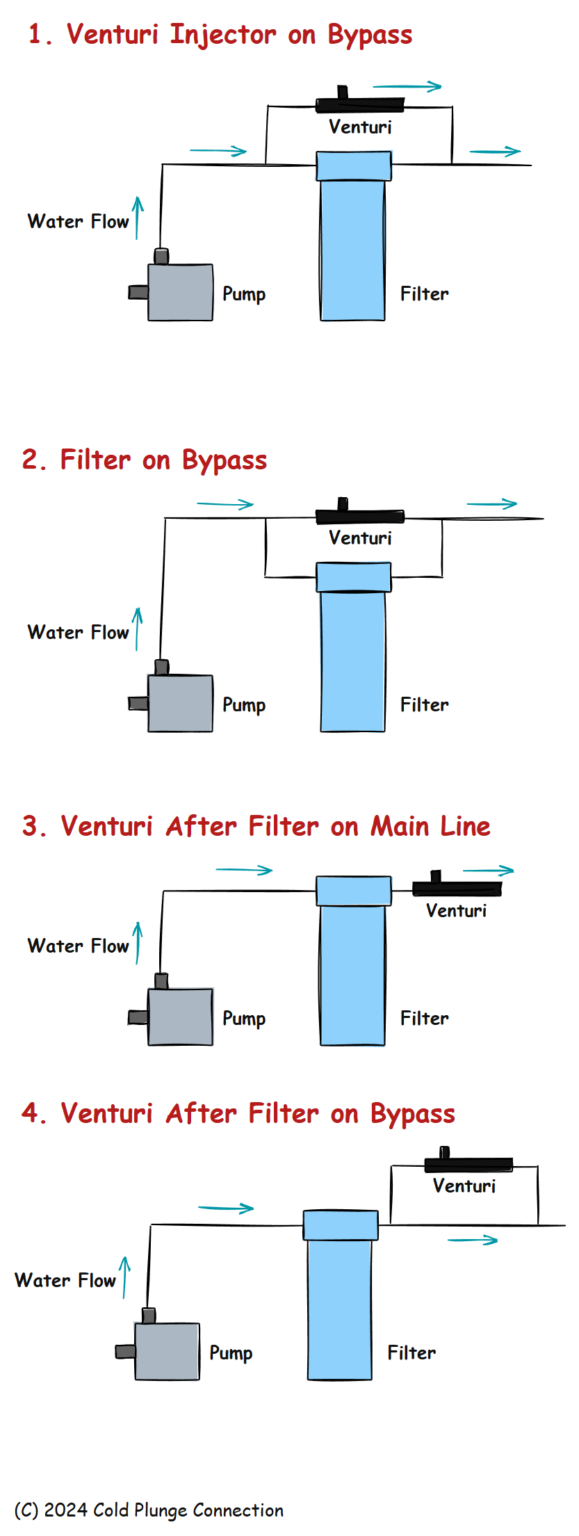
The professional best practice for Venturi injectors plumbed in hot tubs and swimming pools is to be installed on a bypass after the main filter (# 4 in the drawing). Most of the pictures and instructions given on social media do not follow best practices.
Constant Air Flow
There is one more practical issue worth knowing about. When an ozone generator tube is connected to a venturi injector, air is being pulled into the cold plunge continuously- 24 hours a day, seven days a week- whether the ozone generator is running or not. Ozone generators in DIY cold plunge setups are typically run on timers for thirty to sixty minutes once a day.
The venturi keeps pulling air the entire time the pump is running. Some people say this helps aerate the water. That is true in hydroponic or pond systems where aquatic life benefits from additional oxygen. However, the same is not true for a cold plunge.
When outside air is warmer than the air inside the cold plunge, that warm humid air meeting cold surfaces creates condensation under the lid. When the lid opens, that water can drip down the interior of the lid or onto the upper back wall of the chest freezer. Over time that moisture can contribute to mildew, mold, or general funky buildup on the lid or upper wall. At minimum it is additional cleaning and maintenance. It is not a dealbreaker for everyone, but it is something most venturi guides don’t mention.
2: Simple venturi (APEX86)
This is the middle path, and for a specific type of chest freezer builder it is a genuinely strong option.
Lars Remsen, a mechanical engineer and valued member of our DIY cold plunge community, developed the APEX86 Complete Minimalist Filtration System. It is a compact, submersible filter system that includes a high-flow venturi as part of its design. The venturi is integrated into the return fitting on the filter housing rather than requiring custom plumbing.
I am an affiliate for the APEX86 setup and think Lars has done good work.
The practical advantage of this approach over a fully plumbed venturi is significant: it is a defined, contained system rather than a custom plumbing project. You are not starting from scratch trying to match injector sizes, flow rates, and bypass configurations. The venturi is part of the design. And it has a very small footprint.
If you are using an ozone generator with a built-in pump, like the ARC 50P, it’s best to secure the airstone with a zip tie just below where the water exits the return fitting. That keeps ozone delivery near the output flow, which is where you want it.
The honest tradeoff: a venturi, even a well-designed one in a compact system, still makes your ozone delivery dependent on water flow and filter condition. As the filter gets dirty, flow changes. That relationship does not disappear just because the system is more compact.
One thing worth saying directly: the APEX86 high-flow venturi makes it possible to use a wider range of ozone generators, including inexpensive units not specifically designed for cold plunge water sanitation. That flexibility is real, but it cuts both ways. The venturi has no way of knowing whether the generator feeding it is purpose-built for this application or a repurposed kitchen unit. If you are using the APEX86, the ozone generator quality issues I cover in depth here- Why the Wrong Ozone Generator Is Worse Than No Ozone Generator– apply just as much as in any other setup. The venturi delivers whatever the generator produces. If the generator is producing inconsistent or insufficient ozone, the venturi delivers that inconsistency into your water.
The condensation issue from Decision One applies here as well. Because the venturi pulls air into the cold plunge continuously while the pump runs- not just during the thirty to sixty minutes your ozone generator is running- warm humid outside air is regularly meeting cold interior surfaces. That means condensation under the lid, potential dripping when the lid opens, and over time a higher chance of mildew or mold in the lid area. It is manageable, but worth factoring into your decision.
You can find my review of the APEX86 setup here:
Who this is right for: People who want an internal, compact filtration system and are comfortable with a venturi as part of that design. If you like the APEX86 form factor and want everything in one unit, this is worth a serious look.
Who this is not right for: Chiller based setups. Anyone who prefers to go the full DIY route with their own pump and filter configuration. If that is you, I have DIY pump and filter plans that walk you through building your own system: https://chestfreezercoldplunge.com/product/diy-pump-and-filter/
3: No venturi- ozone generator with a built-in pump
This is the approach I have used and recommended for years, and it is still where I land for most DIY chest freezer cold plunge owners.
The logic is simple: keep water circulation and ozone delivery as two separate systems that work together without being physically dependent on each other.
Your pump and filter handle circulation and filtration. Your ozone generator handles ozone delivery. They do not need to be married through a venturi to accomplish both goals.
An ozone generator with a built-in air pump sits outside the tub. Ozone travels through a tube to an airstone placed near the output flow of your pump. The ozone generator does not care about your flow rate, your filter condition, or your plumbing configuration. It just runs.
This was the approach I promoted with the JED 303 for years: 50 mg/hr, built-in pump, no venturi required. When JED Engineering discontinued that line in late 2025, it left a real gap. The ARC 50P fills that gap. It matches the JED 303’s 50 mg/hr output and improves on it in several ways that matter specifically for cold plunge environments, including a weatherproof IPX6 rating and sealed port openings.
If you want to understand why ozone generator selection matters as much as ozone delivery method, I wrote a separate article that covers that in depth: Why the Wrong Ozone Generator Is Worse Than No Ozone Generator
You can also watch my full ARC 50P review here:
Who this is right for: Most DIY chest freezer cold plunge owners. Anyone who wants the simplest, most reliable ozone setup with the fewest variables.
Who this is not right for: People who specifically want an all-in-one internal filtration and ozone system, or who prefer a fully integrated plumbed approach for their own reasons.
Recommended no-venturi setup:
For most DIY chest freezer cold plunge owners, I recommend a purpose-built ozone generator with a built-in air pump, such as the ARC 50P, paired with a properly placed airstone near the pump output.
The ARC 50P is a great choice for anyone who wants:
- the best ozone generator for cold plunge
- ozone generator with built-in air pump
- JED 303 replacement
- JED 203 replacement
- JED 003 replacement
You can find one here on my website:
https://chestfreezercoldplunge.com/product/arc-50p-ozone-generator/
Where to place the airstone / where to place the venturi
Regardless of which approach you choose, the same principle applies everywhere: ozone should enter the water after it has passed through all other equipment, not before.
For airstone setups, place the airstone near the output side of your pump or return flow. Not near the intake. You want ozone mixing into water that is moving away from your equipment, not being pulled directly into your pump, filter, or chiller.
For venturi setups, it should be positioned after the pump, after the filter, and after the chiller or any other equipment in the loop. Ozone is a powerful oxidizer. Introducing it before equipment means it passes through pumps, seals, gaskets, impellers, and filter media before it ever reaches open water. That is how people end up damaging their equipment.
Simple rule regardless of delivery method: ozone enters the water last, after everything else in the system has already done its job.
A note on bubbles
Whether you are using an airstone or a venturi, visible bubbles are not proof of ozone delivery.
Bubbles are proof that gas is moving. With an airstone, a degraded or moisture-compromised generator can still push air through a tube and produce bubbles while delivering little or no ozone. With a venturi, a unit that is not pulling sufficient suction due to low flow or a dirty filter can still work, but that gas may be mostly ambient air rather than ozone.
In both cases the system can look like it is working. The silent failure problem is real. It is one of the stronger arguments for using an ozone generator that was purpose-built for cold plunges, because you want confidence that what is supposed to be happening is actually happening.
Chiller-based cold plunges: a different conversation
Everything above applies specifically to chest freezer cold plunges. Chiller-based setups are a different situation, and the venturi question plays out differently depending on where you are in the process.
If you are still in the planning stage
This is the easier scenario. Because a chiller-based cold plunge already requires external plumbing- water leaves the tub, goes through a pump, through a filter, through the chiller, and returns- adding a venturi to that loop is a more natural consideration than it is in a chest freezer setup.
If you are designing the system from scratch and want to include a plumbed venturi, plan for it now. That means selecting the right injector for your flow rate, designing in unions so the injector is serviceable, including valves for tuning, and using ozone-compatible materials throughout. It is still a variable that requires thought and tuning, but it is far easier to design in than to retrofit.
That said, the no-venturi approach is still valid here. An ARC 50P sitting outside the tub with an airstone placed near the return flow works in a chiller setup just as well as it does in a chest freezer setup. With no venturi, it takes up less space and is one less thing to break or replace. The ozone generator quality issues covered in this article still apply: Why the Wrong Ozone Generator Is Worse Than No Ozone Generator
If you are dead-set against having an ozone tube with an airstone in your tank, plumb in a venturi injector.
If everything is already plumbed and running
This is the harder scenario. Retrofitting a venturi into an existing chiller loop means cutting into plumbing that is already working. That involves unions, valves, potential flow rebalancing, and troubleshooting a system that now has a new variable introduced into it. You might need to upgrade your pump.
My advice: if your existing chiller setup is keeping water clean and everything is running well, think carefully before adding complexity to a working system. The bar for introducing a venturi retrofit should be higher than curiosity or the feeling that you should have ozone.
If your water quality is the actual problem you are trying to solve, start with the no-venturi approach. Add an ARC 50P, place the airstone correctly, and give it time. That is a much lower-risk intervention than cutting into existing plumbing.
The bottom line
Most DIY chest freezer cold plunge owners do not need a venturi injector. They need clean water, fewer things to fail, and a system they can maintain without becoming a part-time plumbing engineer.
For most people, the no-venturi approach- a purpose-built ozone generator with a built-in pump- is the cleanest and most reliable path.
For people who want a compact internal system, the APEX86 is worth serious consideration.
For people who genuinely enjoy building and tuning plumbing systems, a properly designed plumbed venturi can work well but do it right, make it serviceable, and expect some iteration.
The decision is yours, but now you know what the actual decision is.
John Richter has been cold plunging at home since 2014 and building chest freezer cold plunges since 2017. He is the founder of Chest Freezer Cold Plunge and the author of The Ultimate Chest Freezer Cold Plunge DIY Guide. His private Facebook community has over 56,000 members.