
Pond Shield – 7 Steps to Success!
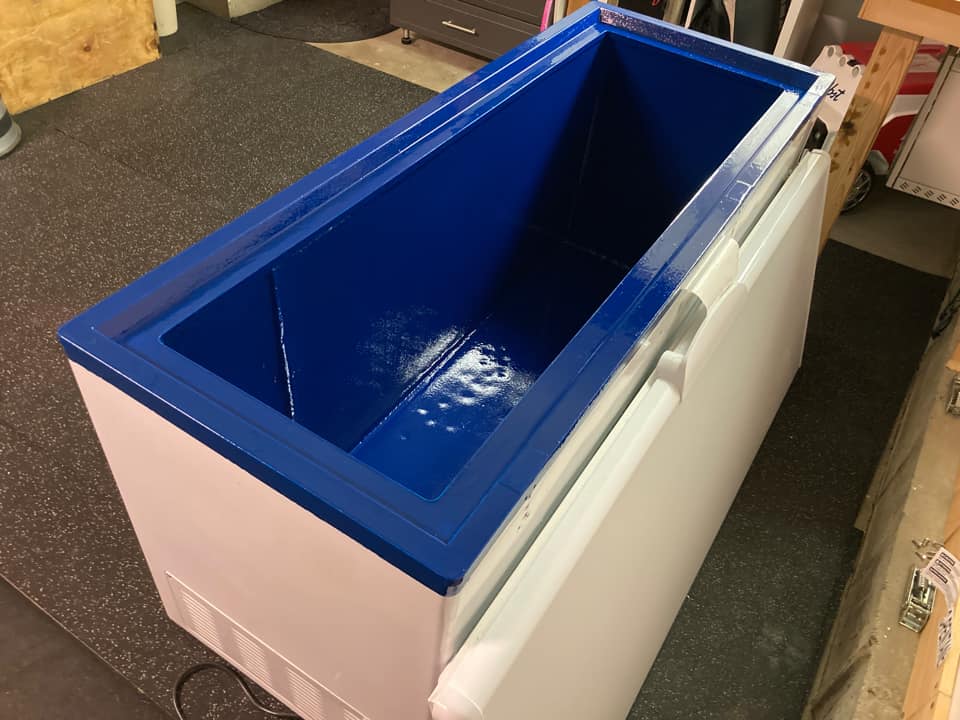
In this post, you’ll learn the best practices for applying Pond Shield (the product) from Pond Armor (the company) to protect your chest freezer.
This article contains Amazon affiliate links. Clicking them helps me support our community and ongoing content, such as this article.
For additional details about supplies, tips/strategies for mixing, applying, troubleshooting, or cleaning the finished product, please see this post in my Facebook group:
https://www.facebook.com/groups/chestfreezercoldplunge/posts/1006001890069101/
Watch a Video
An epoxy resin artist and expert in my community made a video walking through the steps. You can find it in my group here: https://www.facebook.com/groups/chestfreezercoldplunge/posts/870857923583499/
1. Before You Start
Application Best Practices
Pond Shield, like Line-X, is a coating. It works great when applied to even surfaces. It is *not* a gap-filler.
Pond Shield serves several main purposes:
1. To act as secondary waterproofing (sealing the seams is the primary).
2. To protect the surface of your chest freezer, and
3. To hold water in your cold plunge in a way that is durable and aesthetically pleasing.
Materials
1. Two or three 1.5 Qt. kits of Pond Shield
https://amzn.to/431QsZ8
2. Nitrile gloves
https://amzn.to/4f3OsX2
3. Small measuring/mixing cups (mixing sticks included)
https://amzn.to/4hekRvr
4. Large Paint Pan for refills and each time you mix (or you can mix it in the bottom of your chest freezer)
https://amzn.to/48jR1S9
5. Paint Brushes (use high-quality, cut to 1 – 1.5 inches long)
https://amzn.to/3YCjRd2
6. Good quality roller handle for 6-inch pads (this one comes with 2 pads)
https://amzn.to/40k1tXH
7. Microfiber Nap Cloth Refills (get ones that do not shed, use at least one pad per coat)
https://amzn.to/3BYU4mF
8. Masking Tape (For best results use masking tape meant for resin)
https://amzn.to/40jwcV1
9. Plastic tarp to protect the ground AND to cover the project while it cures (get one for each)
https://amzn.to/3NGdXRT
10. Denatured Alcohol – 99% (for diluting if needed)
https://amzn.to/4e1KWLd
11. Acetone for cleaning/degreasing (not available on Amazon; check your local hardware store)
https://www.homedepot.com/p/Klean-Strip-1-Gal-Acetone-Flammable-Paint-Solvent-GAC18/100141096
12. Pigment for epoxy resin (if desired)
https://amzn.to/3umWpEF
13. Epoxy resin flakes (if desired) – Amazon Search, pick your favorite color
Note: Flakes are typically made of vinyl, which is not resistant to chemicals or ozone. Apply a clear top coat over them if you want them to last long-term.
https://amzn.to/4mpbZ8J
14. Respirator (Half face with Organic Vapor Cartridges)
https://amzn.to/3AmLbTh
15. Chemical-resistant apron
https://amzn.to/3C0GvmN
16. 60 to 400 grit sandpaper.
Coarse (60 – 80)
Medium (100 – 150)
Fine (180 – 220)
https://amzn.to/3YD17Ks
17. Paper towels for wiping up spills/dust
18. Shop vac or vacuum cleaner to remove debris from sanding
Variables That Can Affect the Number of Coats Needed
- Total surface area- there are variations in chest freezers of the same size; not everyone covers the same places,
- Number of coats applied – some people apply fewer or more than the number of recommended coats
- Thickness of each coating – thicker coats require more product
- Application method – brushes typically use less product than rollers
- Surface texture – textured bare metal interiors may use more product than a smooth white enamel interior
- Timing of coating – if you let each coat dry before applying the next, it will require more product
- Spills, waste, mistakes – mixing errors can lead to waste
- Ambient temperature – cooler temperatures can make the product thicker and require more coats
How Many Kits Do I Need
Typical Pond Shield applications only require 2 – 3 coats. However, a cold plunge is not typical, and with three or fewer coats, we have many reports of the cured product getting chipped from pumps or filters.
Best results seem to come from applying four coats.
Fewer than three coats will likely not result in good enough coverage. Five or more coats can add too much weight and can cause the layers to peel off.
For a 15 cubic feet (400 L) chest freezer, one or two 1.5 qt. kits are suggested.
For chest freezers larger than 15 cu ft (400 L), two or three 1.5 qt. kits should be used.
If in doubt, it’s better to have the extra kit on hand and not need it than to need it and not have it.
What Color Should I Use
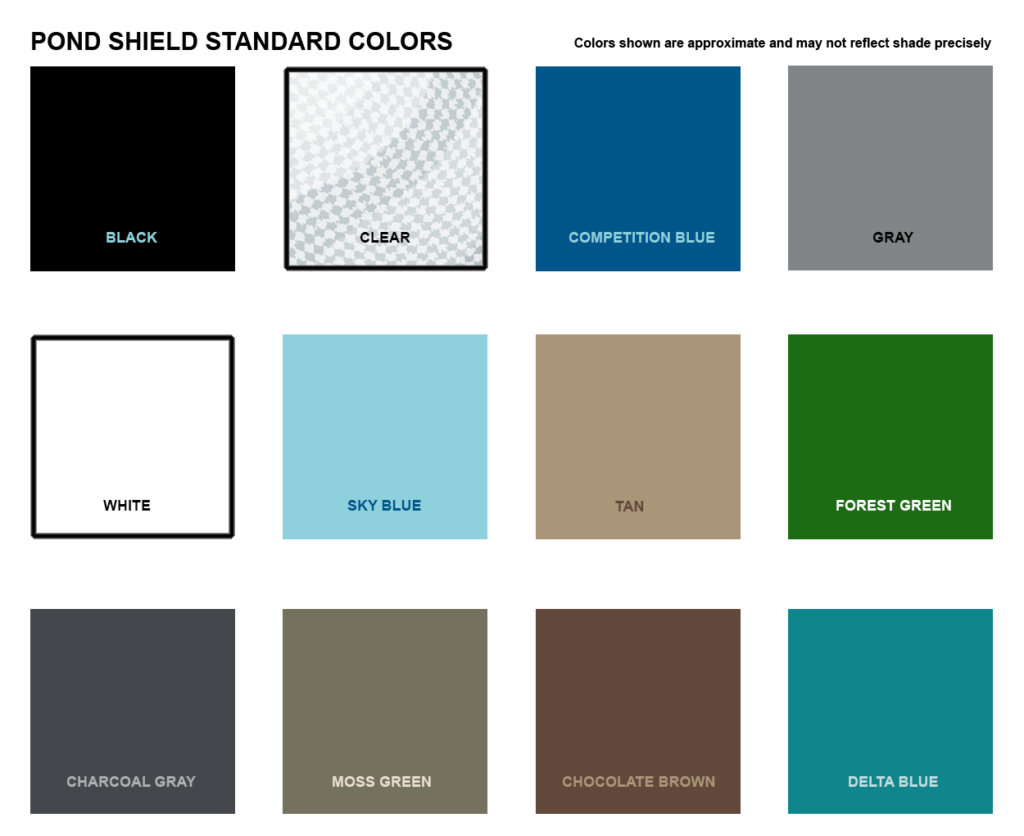
Pond Shield comes in various colors, including clear. Use whatever colors you like. Lighter colors make it easier to see dirt and water quality. If you want a custom color, select “Clear” and add pigment of your liking. Be sure to use pigment that is specifically meant for 2-part epoxy resin. There is a link in the materials list.
Here is a swatch of available colors from Pond Armor. Yes, they can be mixed and matched.
Where to Order
Pond Shield can be found online in most countries.
Check the Expiration Date!
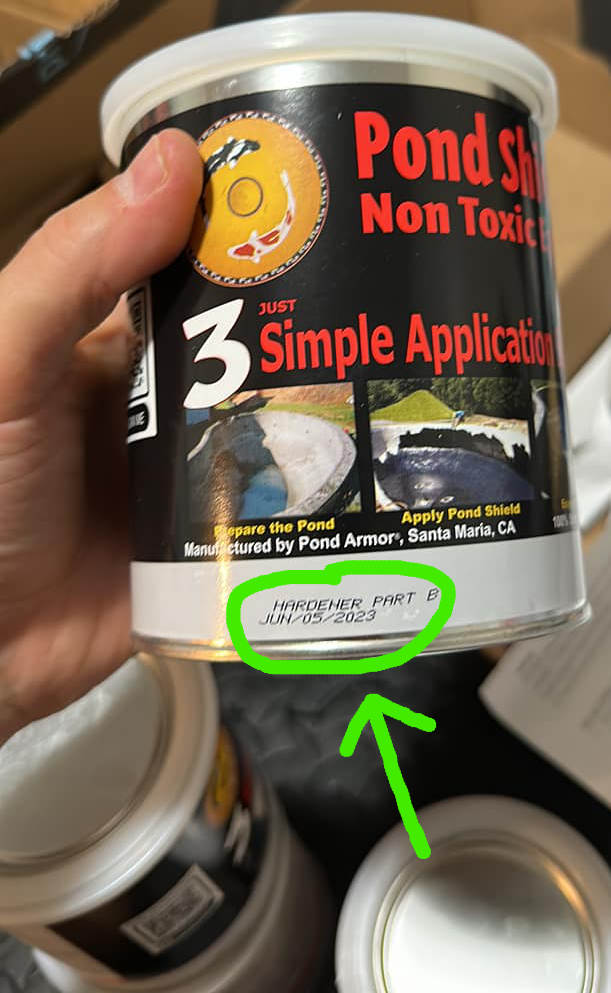
Pond Shield has a shelf life of 24 months. If it is past the expiration date, exchange them for newer ones.
The date on the can is the date it was manufactured.
Read The Instructions!
Read all of the instructions here and the instructions that come with the Pond Shield product. I’m always amazed when people make a catastrophic mistake that could have been avoided had they taken a few minutes to read the instructions before starting. PAY CLOSE ATTENTION TO THE WEATHER REQUIREMENTS. Temperature and humidity can make or break a Pond Shield application.
Did I mention to read the instructions before you start? The instructions included with Pond Shield should be read and followed, along with the information here.
The single largest reason for Pond Shield failures is that people do not follow all of the instructions!
What Parts of the Chest Freezer Should Be Coated?
If the edge of the Pond Shield application is exposed to water over time, water can get underneath and cause it to peel off. The same goes for Line-X, by the way. Because of that, for the best results, Pond Shield should be applied to the entire inside and all of the plastic trim on the top wall, including the small piece that is above the outside walls.
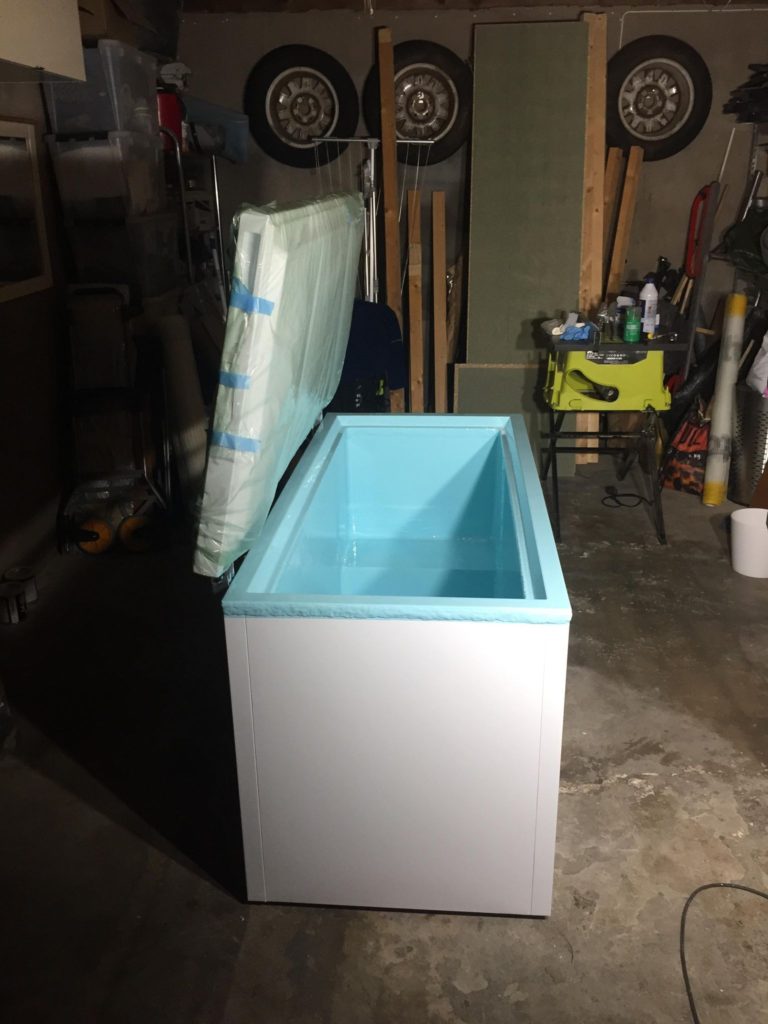
For an even stronger application, apply it about 1″ (2.5 cm) down the outside wall of the metal wall. If there is any seam or gap between the trim on the outside and the exterior walls, seal it with a thin bead of epoxy putty.
Ambient Temperature and Humidity
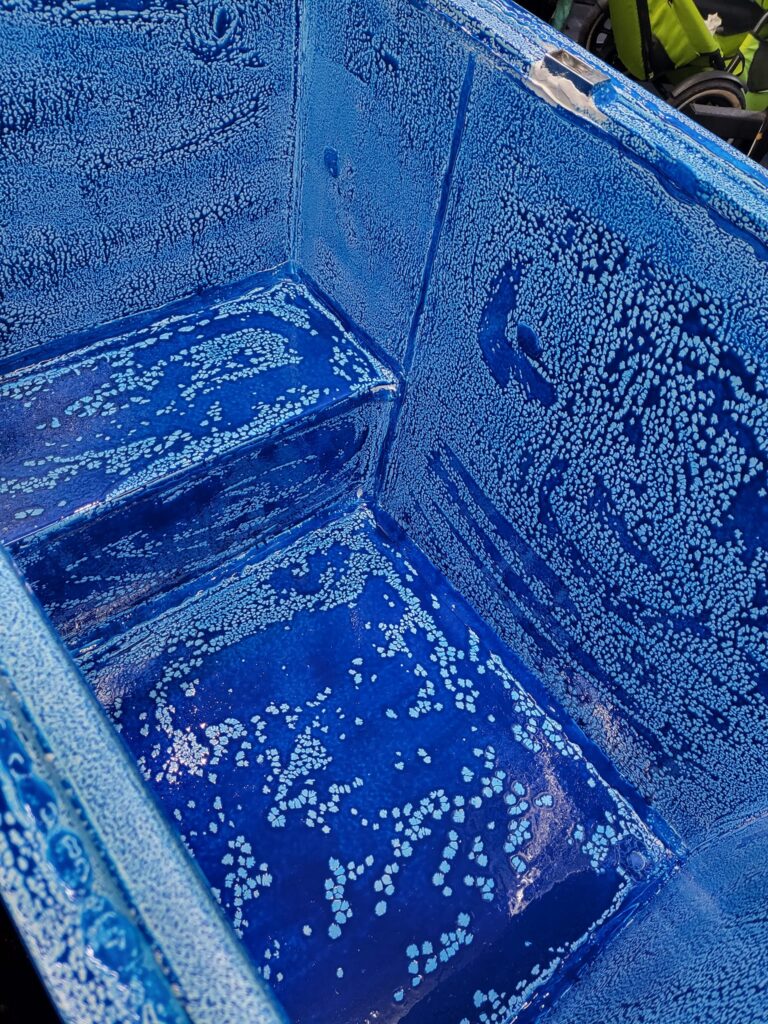
The air temperature and humidity where you are working can make or break a Pond Shield application. You can do everything else 100% right, but if the temperature or, especially, the humidity is outside of the recommended range, you can have problems.
The minimum temperature range to apply Pond Shield is 50°F / 10°C. The ideal temperature range is between 75°F – 85°F (24°C – 30°C).
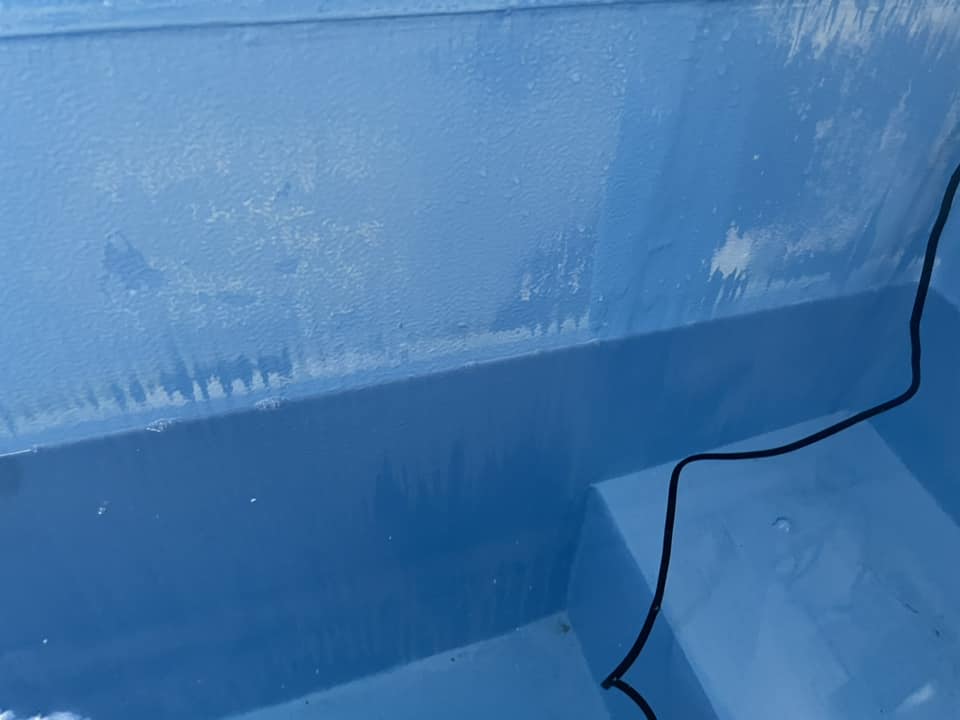
The ideal humidity is below 50%. If the humidity is above that, you can have serious problems.
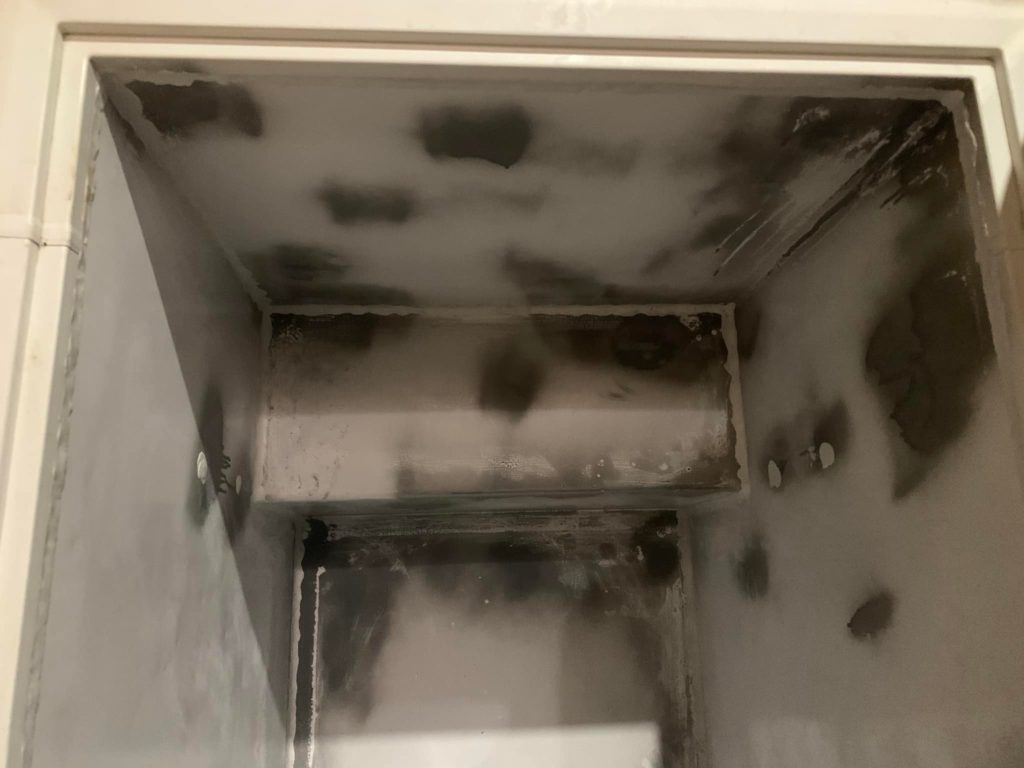
One person in our community meticulously followed every single step of preparation correctly. The only thing he did not know was that his ambient humidity was very high. The picture below shows what happened.
He had to remove the entire first application and start over.
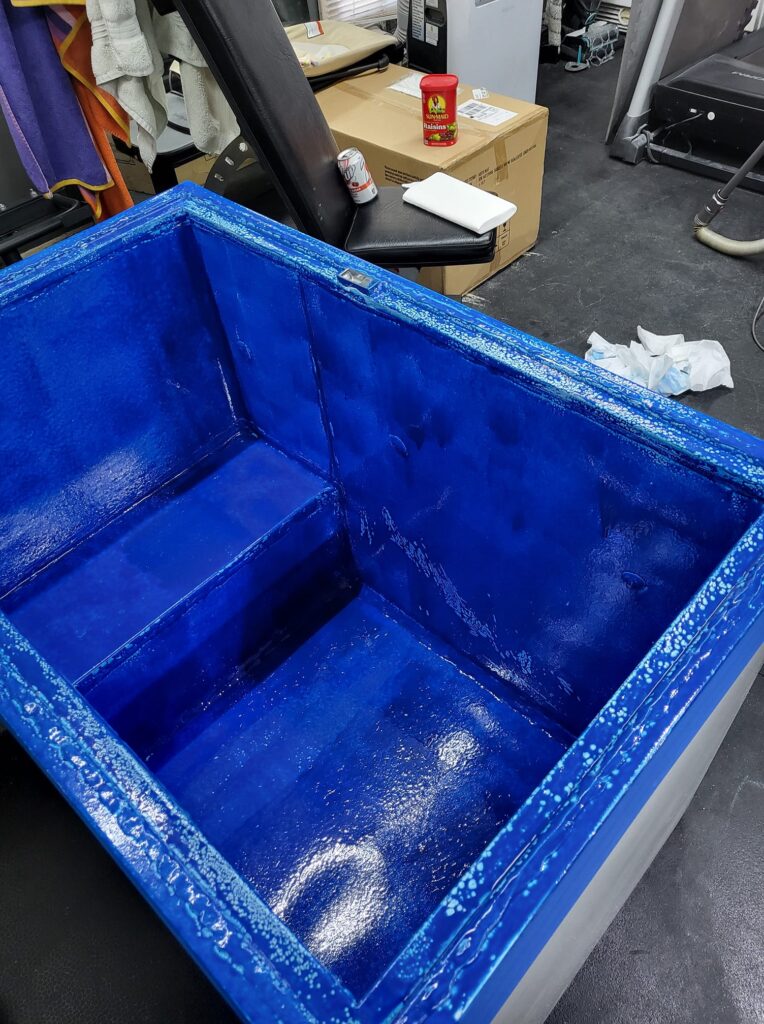
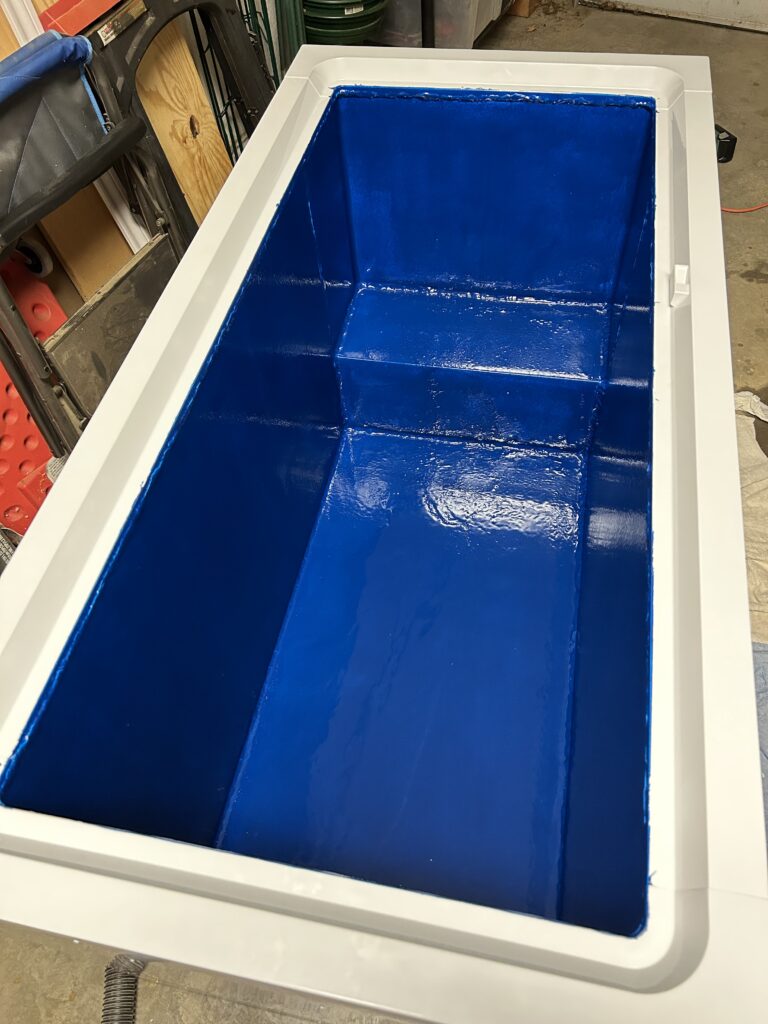
After moving his chest freezer into a closed area and running a dehumidifier to get the humidity below 50%, he tried again. This is a picture of his new first coat:
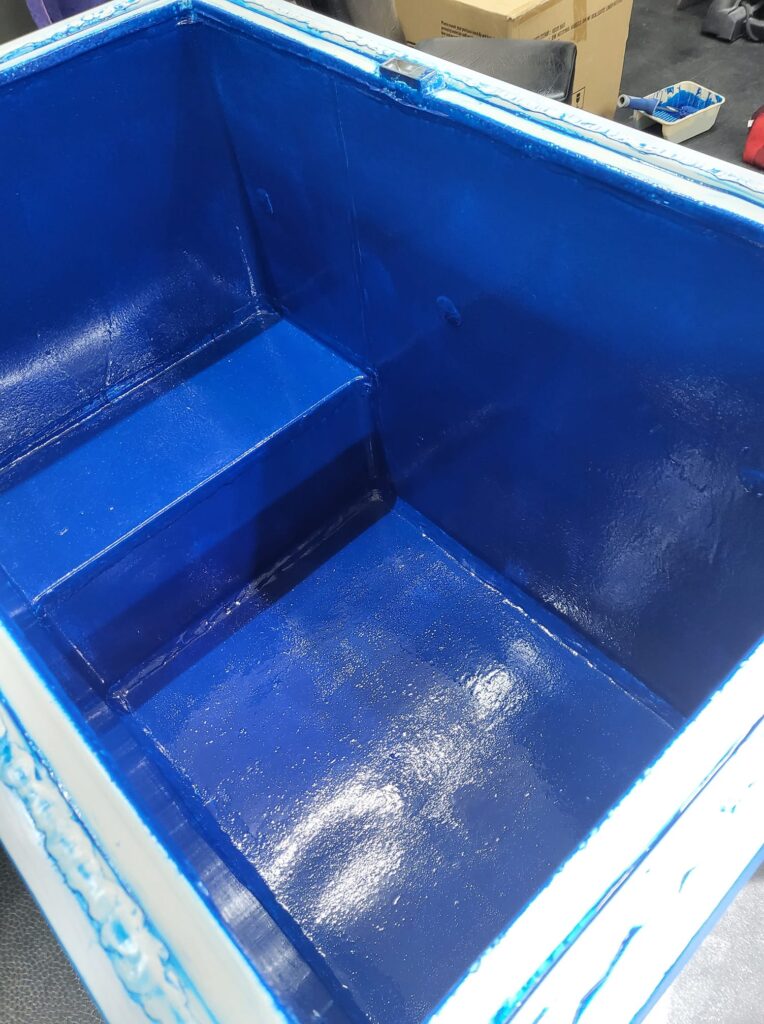
The picture below is after the second coat. Problem solved!
Pond Shield should be applied in an area that is dry. If it gets wet before it cures, there will be problems.
If you choose to bring your chest freezer into an enclosed area and rent a dehumidifier, there are a few things to keep in mind:
1. Always wear a respirator with a filter that is rated for chemical use. While Pond Shield is VOC-free after it cures, it is best not to breathe in the fumes while it is being mixed or applied.
2. Ventilate the area.
3. For best results, the humidity level should remain constant for the entire 7-day curing time. If you’re willing to risk it, you can remove the chest freezer from the area 48 hours after the final coat, provided it is no longer tacky to the touch, but I don’t recommend doing that.
How Long Will It Take?
Many variables affect the project time:
- Ambient temperature and humidity
- Your experience, attention to detail, and work ethic
- Tools used
- Material used to seal the seams
- Number of coats applied
- Methods used
- Working alone or with another person
Here is a rough guideline:
- Prep work: 4 – 8 hours
- Application (3-4 coats): 4 – 6 hours
- Full Cure: Wait 7 days
I suggest setting aside a full day for prep and a full day for application. Give yourself time for breaks, ensure you have all of your materials on hand, and are familiar with all of the instructions.
2. Prep the Surface
There are two main steps to preparing the surface for Pond Shield. They are both necessary to improve adhesion. If you skip these steps, there is a greater chance of your Pond Shield peeling off.
A. Sanding
Epoxy resin doesn’t adhere well to metal. It is necessary to rough up the surface with sandpaper if you want it to last long-term. Sandpaper comes in various grits (roughness), each used for different purposes. If you look at various construction, woodworking, handyman, and building supplies websites, they can all have different ranges and definitions for each grit. There is a section further down in this article that goes into detail about the different grits.
Don’t worry if the grit is not an exact match. If you are close to the specified grit and are thorough in your work, it will be OK.
Sand the entire surface with coarse (60-grit) sandpaper.
Because the chest freezer walls can be easily damaged, I recommend sanding by hand. If you are comfortable using power tools and know you can use a powered sander without applying too much pressure, you can use one for wide surfaces. The corners will still need to be sanded. Vacuum up the dust with a soft brush attachment or use a tack cloth to clean up the dust.
The entire surface should feel rough to the touch. Do you feel any smooth spots? Sand them again until they are rough.
Do not sand until you are ready to begin working. If you sand and leave any metal exposed, it may begin to rust after a few days.
Sanding Tip
Scribble lines with a marker over the entire surface to be sanded. Sand away until they are gone. This simple trick helps you keep track of your progress, ensures that you sand all surfaces, and helps prevent over-sanding.
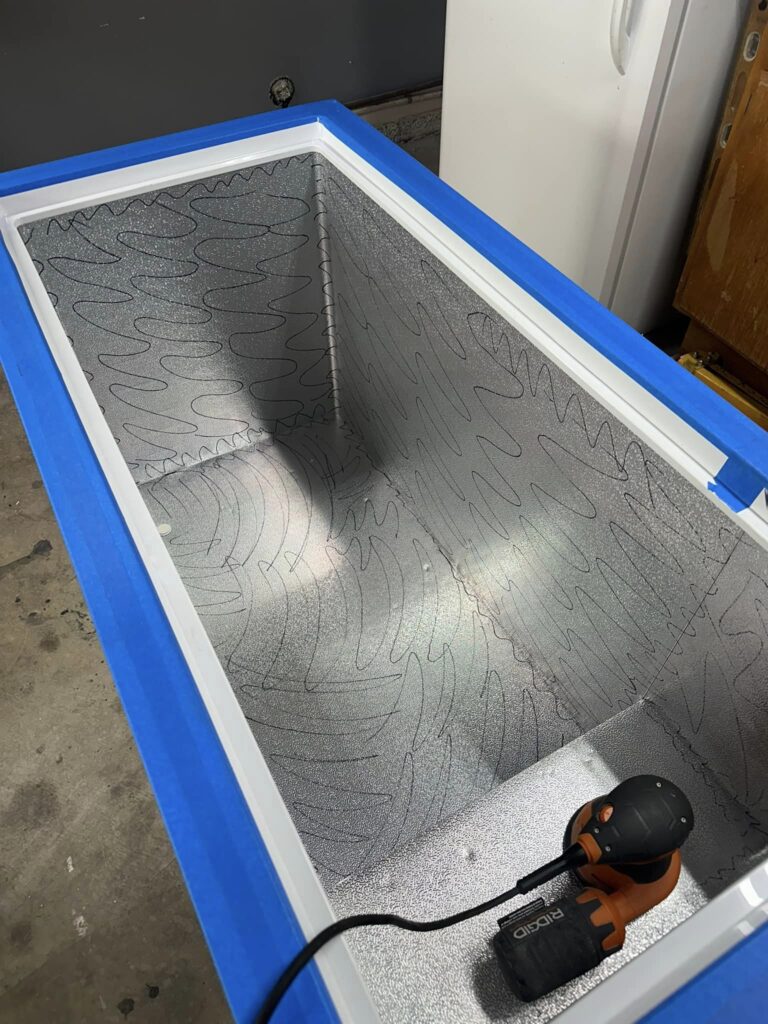
What to sand:
i. Bare Metal
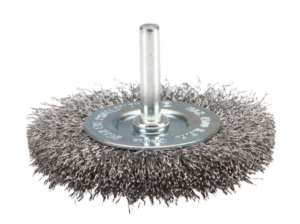
The entire surface needs to be roughed up. Yes, including the “valleys” in between the texture, which can be hard to reach with sandpaper. Some people have used a wire brush to do this, but be careful – the walls are paper-thin.
ii. White Enamel
The ultimate best practice is to remove all of the enamel; however, this can be an enormous undertaking. However, that enamel is baked on at the factory and actually makes a very good surface for Pond Shield, if the proper steps are taken. So, the next best practice (which is getting good reports so far) is to rough it up and be sure that there are no enamel flakes peeling off. Some metal underneath may be exposed. If that happens, don’t panic! It’s totally OK. If a little bit comes off and exposes the metal underneath, that’s OK. If most or some of it remains after standing, that’s also OK. See step 3
iii. Plastic Trim
Rough up the plastic trim.
iv. Rust/corrosion
If there is any rust or corrosion, it must be completely removed by sanding or chemical rust removers, such as CLR.
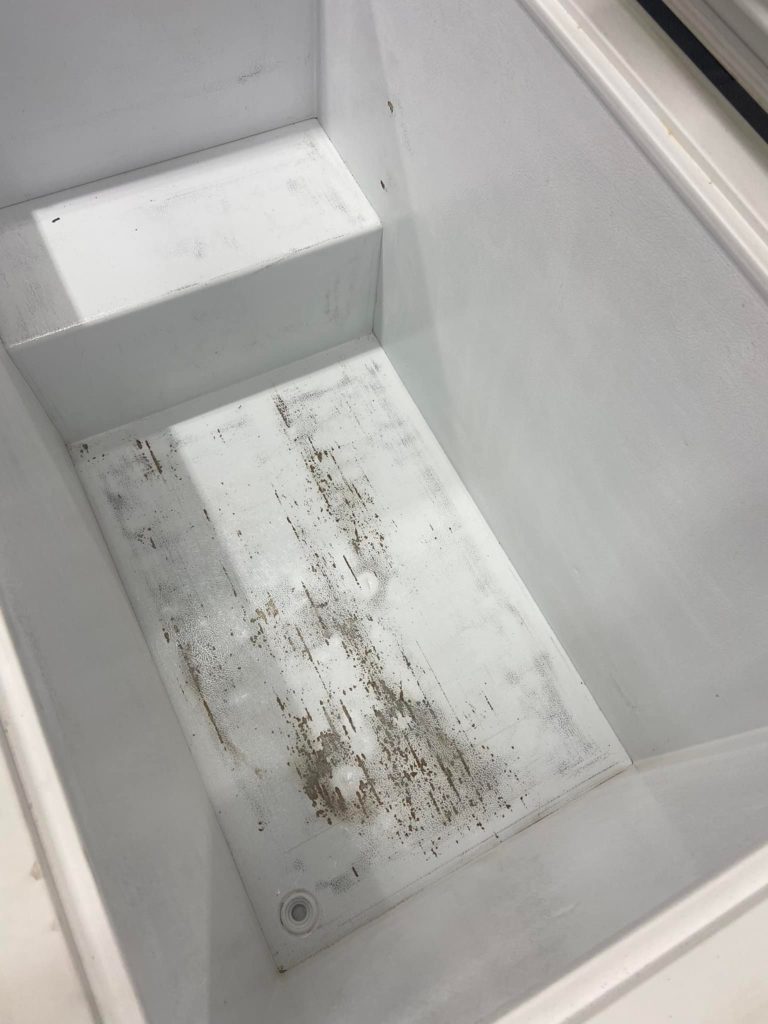
After sanding
After you sand, use a vacuum cleaner or tack cloth. Then wipe the entire surface with isopropyl alcohol or acetone.
B. Cleaning/Degreasing
After sanding, all dust and debris must be removed. Use a vacuum cleaner or a tack cloth. That will take care of the big stuff. However, there is one more step. During manufacturing, oil can be applied or build up on the surfaces. Use a microfiber cleaning cloth to wipe the entire surface with isopropyl alcohol or acetone. Seriously, do not skimp here or get in a hurry. Make sure the surface is 100% free of debris, skin oils, or other residue. Wear gloves while you do this.
Do NOT touch the surface after you have cleaned it. Oils from your skin can prevent Pond Shield from sticking to the surface. Wear a bandana to prevent your sweat from dripping onto the chest freezer.
3. Seal the Seams
As mentioned at the beginning of the article, it is worth repeating, Pond Shield is a coating, NOT a gap filler. It is also your secondary form of waterproofing.
Sealing the seams with an appropriate material is your primary waterproofing, AND it acts as a filler to which Pond Shield can adhere. In the industry, the bead of material in a 90-degree corner is sometimes referred to as a “fillet.” This provides much better long-term durability. If you apply a coating to a 90-degree corner, there is a much higher chance of it cracking, because it is a weak point.
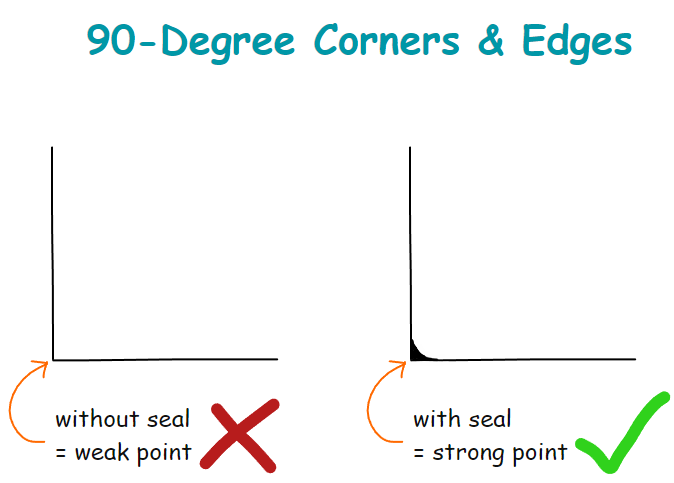
Seal all seams with 2-part epoxy putty. JB Water Weld is the gold standard. If you live in a country where JBWW is not available, find a comparable product, such as Selleys Knead It Aqua. Other options include All-Fix and PC11.
The Pond Armor tech said that Bondo could also be used, but so far, we have no reports from anyone who has done so. Let the 2-part epoxy putty cure for 24 hours for the best results. Ensure that it is 100% solid and has no gray streaks.
See this article for best practices on sealing the seams:
https://chestfreezercoldplunge.com/sealing/
Be diligent and patient. If you want bonus points, find joy or at least satisfaction in the process.
One common question: Should the seams be sealed before or after applying the self-etching primer (SEP)? SEP is designed to create a bond between a metal surface (eg. your chest freezer) and a 2-part epoxy resin (eg. Pond Shield). Epoxy resin (Pond Shield) will already bond well to epoxy putty (eg. JB Water Weld). Therefore, for the best long-term results, apply the epoxy putty (JB Water Weld) first to seal the seams and create a fillet, and THEN the SEP over onto the metal. Do not apply SEP to the epoxy putty (JB Water Weld).
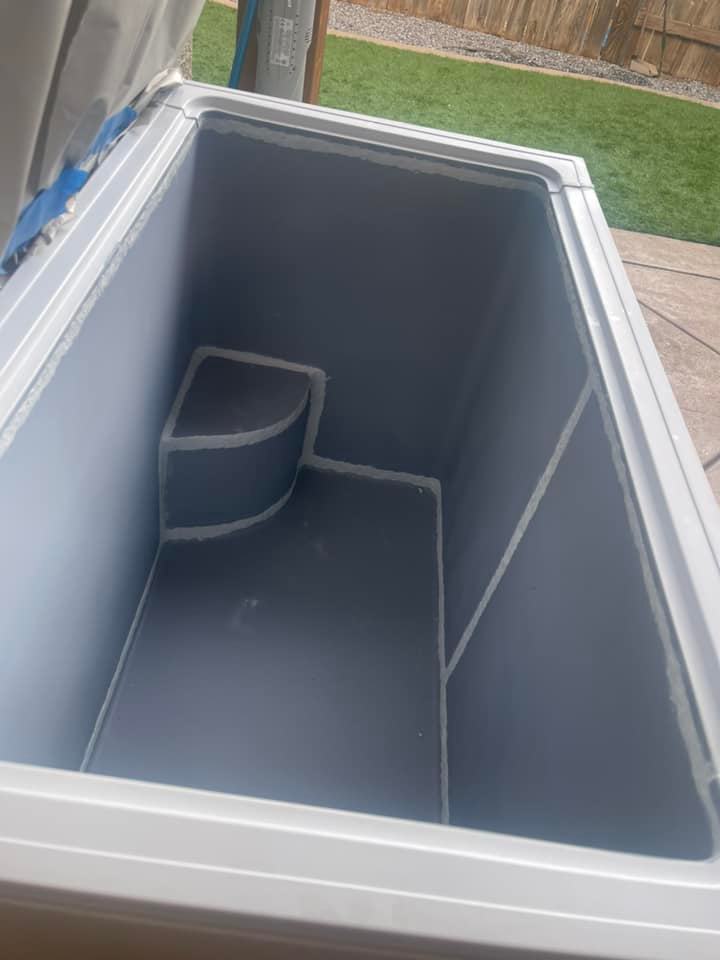
The Compressor Folds
The front top and bottom edges over the compressor are typically folds, not seams; however, a pond shield should be applied.
Here is why: Epoxy resin works great on wide, even surfaces. It does not work well when applied over a 90-degree angle. If you add a bead of 2-part epoxy putty over that fold, there is more surface area to adhere to, and it makes an even transition from the horizontal to vertical surface. See the picture below for what can happen over time.
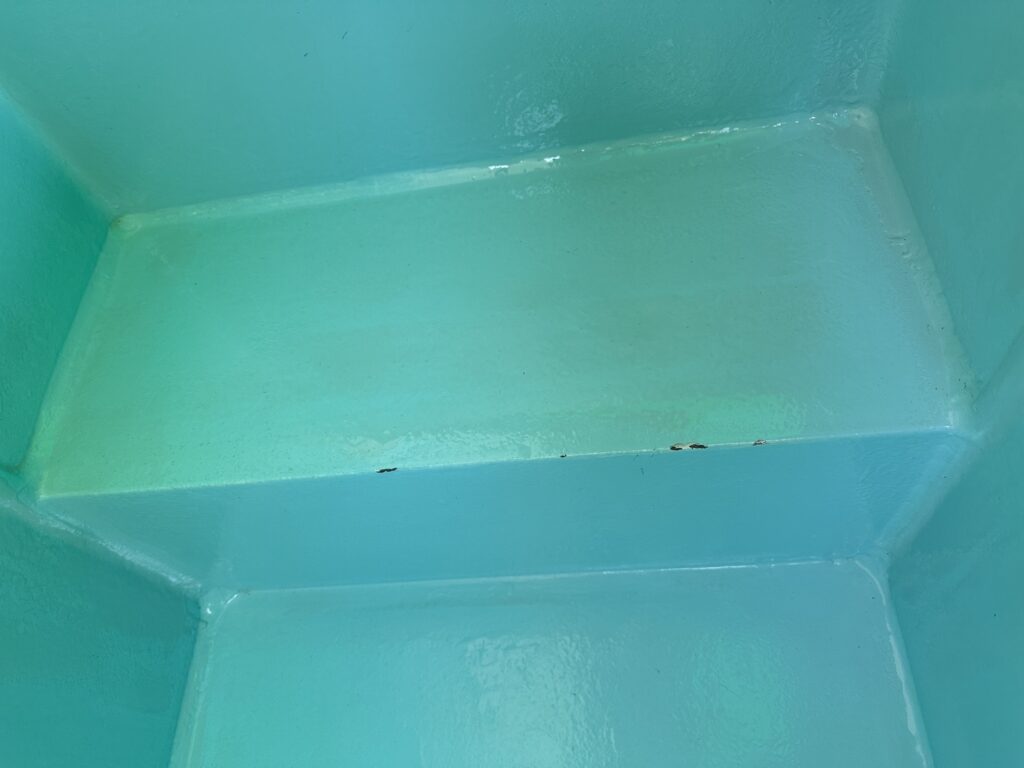
If you’d like to eliminate the possible risk of that happening, apply a bead of JBWW over that fold, 1/2-inch (13 mm) over the top and down the front.
Here is an example of excellent work done applying a fillet on the top outside edge and bottom inside fold by Louise H.
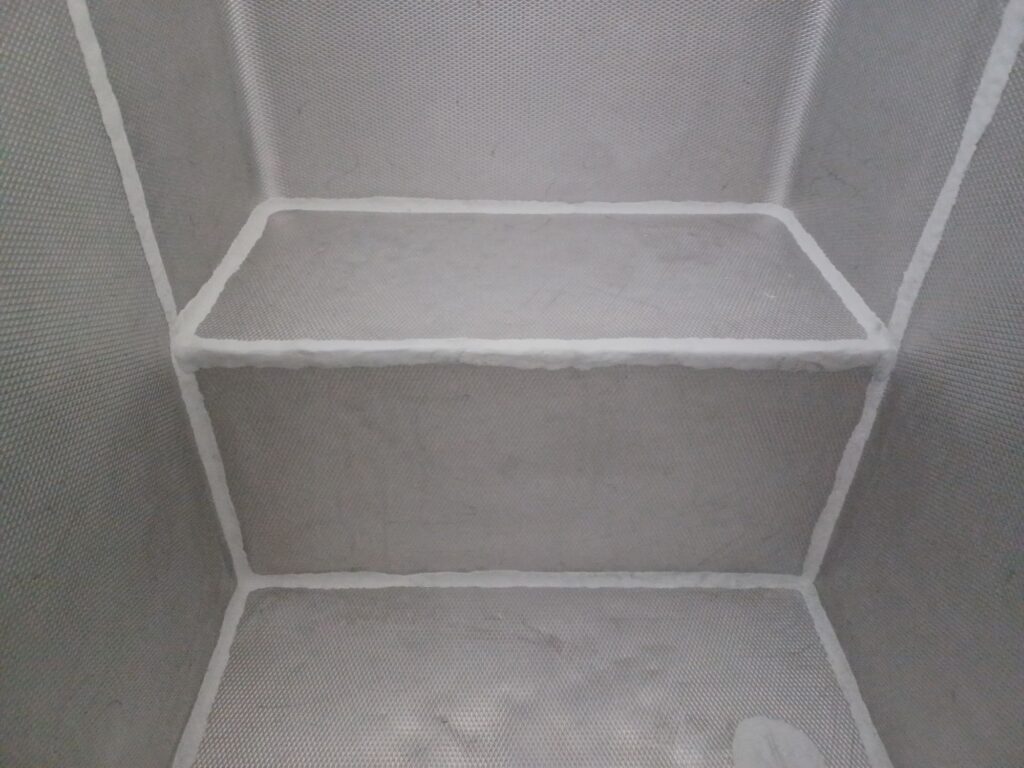
What about other products?
Do not seal the seams with silicone, moisture-cure polyurea, marine adhesive, or caulking of any kind because Pond Shield will not adhere to it and can peel off over time. What about polyurethane? Inquiries to Pond Armor were not answered. There are different types of polyurethane products available. The safe bet is to stick with what is recommended. If the product cures via moisture, it’s likely not a great idea to use it. Many, if not most, of the problems people have with Pond Shield come from taking shortcuts and not following directions.
Outside the Chest Freezer
Always go up and over the top trim to prevent water from getting behind your coating.
You can end your application on the plastic trim outside of the chest freezer. Some people prefer to extend the application a bit down the outer wall. It’s fine to do that, but there is a gap between the trim and the chest freezer wall; it should be sealed first. There is no issue of moisture intrusion at this gap. However, the seal will act as a fillet, which is best practice for Pond Shield (which is a coating, not a gap-filler).
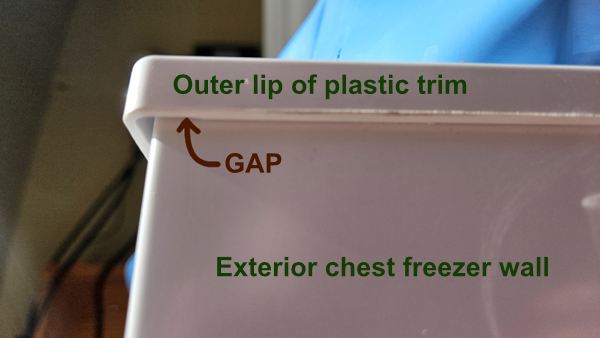
Top Wall Trim – To Seal or Not to Seal?
The top wall trim on a chest freezer is typically made of four pieces. In some cases, it might be one solid piece. If your trim is made up of four pieces, there will be four places where they overlap. If the top piece overlaps tightly against the bottom piece, there is no need to seal here. If there is a gap, yes, add a thin bead of sealant. There is no risk of water intrusion here, but it does act as a fillet, which is important for long-term durability.
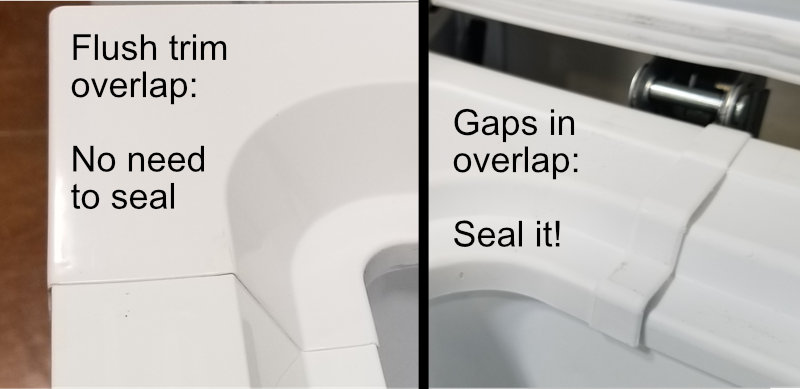
4. Sand Again
Wait 24 hours for your epoxy putty to completely cure. Sand the cured epoxy putty with 60-grit sandpaper.
Vacuum the dust or use a tack cloth, and wipe with a microfiber cloth and isopropyl alcohol or acetone. Let all of the alcohol or acetone dry (it evaporates quickly) before going to the next step.
5. Apply Self-Etching Primer as Needed
A primer on primers
A primer is a base coat applied before painting to improve adhesion, create a smooth surface, and protect the material underneath. It prepares the surface so the paint goes on evenly and lasts longer.
The difference between a regular primer and a self-etching primer is that a regular primer simply sits on the surface. In contrast, a self-etching primer chemically bonds with the metal. This creates a rougher texture that improves adhesion, making it particularly useful for applying 2-part epoxy resin to a metal surface.
Can I use a different kind of primer than self-etching?
Other types of primers are available, but do not use them. Read the label on the can. Seriously. Read the label. People frequently ask if they can use a product such as
- primer
- acid-etch primer
- weld-through primer
- Billy-Bob’s all-purpose primer and desert topping
Ok, I made up the last one. However, if it specifically doesn’t say “SELF ETCHING” on the can, don’t use it!
“But what if I can’t find self-etching primer?”
You aren’t looking hard enough. Any autobody supply store will have a good quality self-etching primer.
“What if I can’t get it locally?”
We have a global economy, and you can order anything online these days and have it shipped to you.
“But it’s too expensive.”
If you think it’s expensive to do it right, think of the cost of your money, time, and effort wasted when your Pond Shield peels off because you didn’t follow the directions. You’ll wish you had ordered the right product.
Self-etching is recommended for a reason.
“But…. (fill in the blank).” OK, you’re persistent. If you don’t want to do it right, and are OK with it failing sooner- possibly way sooner- than later, go ahead and don’t apply SEP if needed, or use the wrong product. If you legitimately can’t get SEP where you live, choose another liner option.
Which self-etching primer to use
Pond Armor specifically recommends SEM on its website. If you can’t find SEM, look at local or online autobody supply shops. Here is an Amazon affiliate link:
Which products to avoid
Use any brand of self-etching primer except Rustoleum.
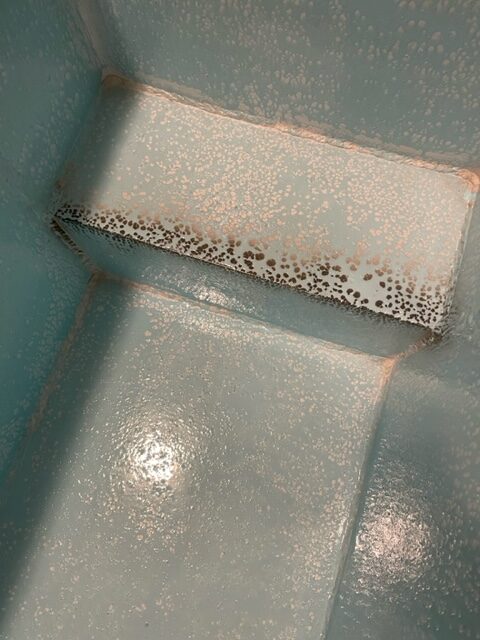
Do NOT use Rustoleum. Again, *any* other brand will be fine. Why not Rustoleum? Pond Armor, the company that makes Pond Shield, has specifically advised against it, and despite this, people still use it and wonder why their Pond Shield peels off. Maybe a picture will help dissuade you from using Rustoleum.
When to apply SEP?
It does matter if you apply the primer before or after sealing the seams. Apply the epoxy putty before the primer goes on. Do not apply SEP to the cured putty.
How to apply
Mask off any areas that will not be coated. Use painter’s tape and drop cloth/ newspaper for wide areas. If you touch or drip sweat on any area where Pond Shield or self-etching primer (SEP) will be applied, wipe it off before proceeding. Any residue (skin oils, dirt, sweat, etc) on the surface can prevent Pond Shield from adhering properly or can cause “fish eyes,” which look like little round pits.
Where to apply?
Cover ALL exposed metal with self-etching primer. One coat is enough.
Where not to apply?
If you have a white enamel interior, only apply primer to the areas where metal is exposed. Primer does not need to be applied to any white enamel remaining after sanding. You do not need to mask the white enamel around the exposed metal. It is OK for the primer to overspray onto the white enamel.
The top trim (plastic) does not need self-etching primer.
Follow the Directions
Follow the directions on the can of self-etching primer for the recommended waiting time before applying Pond Shield. Waiting for 30 minutes is a general guideline, but it could be a bit shorter or longer, depending on the product you are using.
Usually, it is best to start applying Pond Shield before the self-etching primer completely dries, but again, follow the directions that come with your SEP.
If you come back several hours later, or the next day, it is likely that the self-etching primer will already be completely dry. If that is the case, the self-etching primer will need to be roughed up with sandpaper (60 grit) and all residue wiped away before applying Pond Shield. Be careful not to sand so hard that you remove the self-etching primer.
How much is needed?
It depends on how much bare metal there is to be covered, and the volume of primer in your can.
Typically, one 15.5-oz (0.45-liter) can of self-etching primer covers approximately 10 square feet (0.9 square meters).
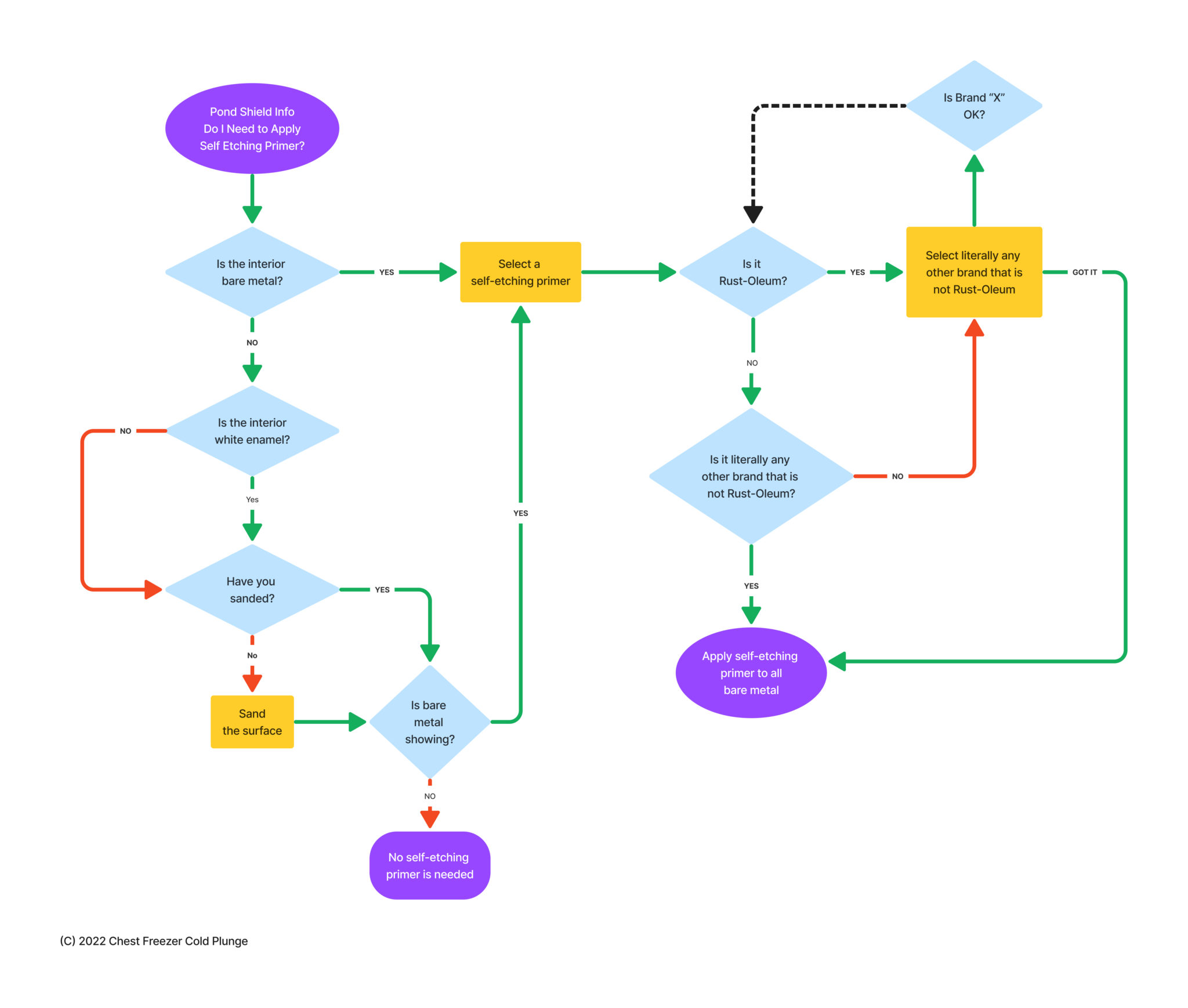
Flow Chart – Do I Need to Apply Self-Etching Primer?
Right click and select “View Image” “Open Image in New Tab” or similar to view a higher-resolution image of the below flow chart.
6. Mix and Apply Pond Shield
After the self-etching primer dries, apply 3 – 5 coats of Pond Shield.
Where to apply?
Cover all interior surfaces, and the entire plastic trim, including the top and down the outside edge. It is OK to go below the plastic trim down the outside wall an inch. If there is a gap between the trim and the outer wall, be sure to apply 2-part epoxy putty or Bondo to create an even surface for the Pond Shield to adhere to.
Why Up and Over the Top Trim?
Even the highest quality and most durable of coatings, such as Line-X XS 350, are susceptible to damage from water over time. If an edge of the coating is exposed to splashed water or condensation over time, moisture can work its way between the coating and the covered surface, causing it to peel off. In the trades, the technical term is “delaminate.” The same applies to Pond Shield.
If you want your cold plunge to last long term, invest the bit of extra time to apply it up and over the top trim.
Read and Follow the Product Directions
Follow the directions on the kit. If you are in my Facebook group, search for “Pond Shield Master Post” for expert tips on mixing and applying. There is also a video with tips from an experienced epoxy resin artist.
You will need to join my free Facebook group. Be sure to provide legit answers to the screening questions and agree to the rules. Here is the link to the Pond Shield Master Post:
https://www.facebook.com/groups/chestfreezercoldplunge/posts/1006001890069101/
Tips for Mixing
Here are a few tips for mixing:
1. Mix in small batches. Pond Shield has a limited working time, so apply it immediately after mixing.
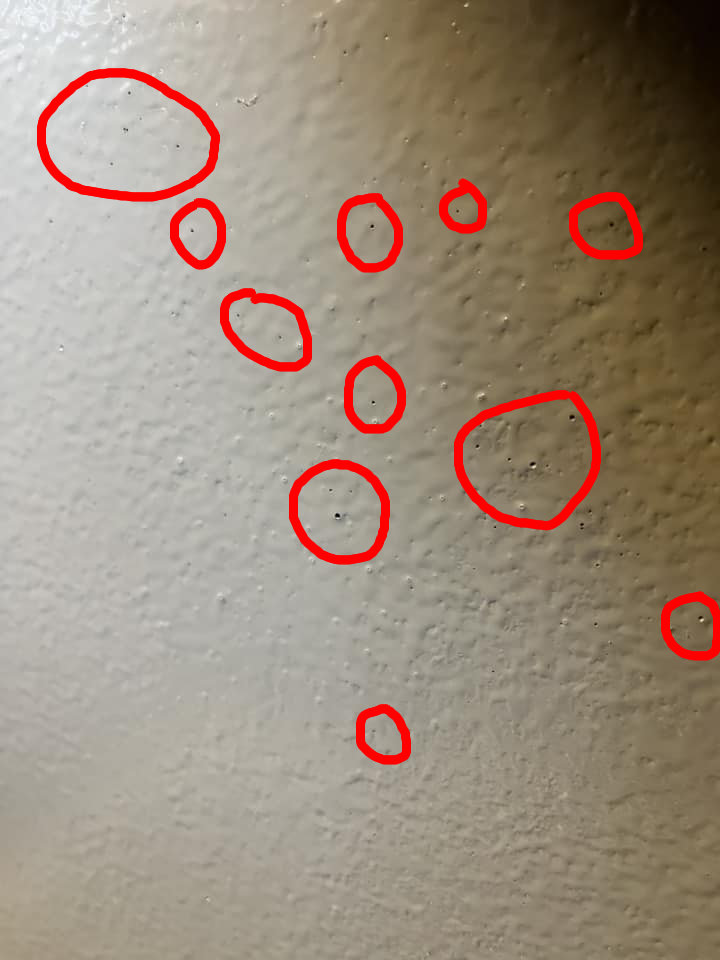
2. We do not recommend using a drill attachment to mix the two parts because it can introduce bubbles, which can show up as lumps or dimples after curing. See the picture below. It is best to mix by hand, slowly.
3. Measure accurately. Use clean, marked measuring cups for each new batch to ensure you are getting the correct amount.
4. Use a separate container for Part A and Part B
5. Scrape the sides and bottom. Mix for about 3 – 5 minutes (but no longer!).
6. Use a stir stick designed for mixing epoxy.
7. Transfer your mixed epoxy to a second container to ensure that any unmixed resin or hardener does not get applied to your cold plunge.
8. Use a new container for each batch. Yes, you’ll spend a few more dollars on supplies. The last batch of gunk on the side walls of your container throws off the ratio of the next batch and makes it harder to stir. You’ll thank me later.
Brushes vs Rollers
Rollers work well for wide areas. Brushes are better for corners and edges.
Here are some tips for rollers:
- Use high-quality microfiber rollers meant for 2-part epoxy resin.
- Wash it well and let it dry completely before using it.
- Use a new roller for each coat.
- 4″ rollers seem to work better than larger ones
Here is an Amazon affiliate link for an example of what kind of roller to look for:
Here are some tips for brushes:
- Use a high-quality brush.
- Use a 4-inch stubby bristle brush
- Switching between a brush and a roller can help make the coats more even.
The finished coat is supposed to be 10 mils / .25mm thick. It’s difficult to determine exactly how thick that is. If there is any doubt, apply an additional coat. You are already investing time and money into applying Pond Shield, so you might as well do the best you can. There is a risk of an application that is too thin. There is no practical downside to having a third or even fourth coat of Pond Shield. Having additional coats will not affect the chest freezer’s compressor at all or its ability to chill your water.
How Many Kits are Needed?
One or two 1.5 qt. kits might be needed for a 15 cu. ft. chest freezer. Use two kits if you want to apply three or more coats. Two or three 1.5 qt. kits might be needed for a 21 cu ft chest freezer.
Timing To Apply Additional Coats
After applying your first coat, you will most likely have some thin or bare spots. This is OK. It is best to wait at least one hour (but no more than 10 hours) before you apply the second coat. When you add subsequent coats, the same rule applies – wait at least one hour, but no more than ten hours.
If you wait more than 10 hours, the previous coat will need to be sanded before the next coat is applied. Rough it up with sandpaper, and vacuum or wipe up the dust. Do not apply acetone or any other degreaser.
Sanding Before Applying the Next Coat
If you wait more than 10 hours and the coating has dried, what grit of sandpaper should be used before applying the next coat? There are varying opinions, but it depends on the quality of the dried coat. Here are some guidelines.
Coarse Grit (60 – 80): Use if there are larger imperfections, drips, or high spots on the surface.
Medium Grit (100 – 150): Use if there are medium-sized imperfections.
Fine Grit (180 – 220): Use if there are small or no imperfections.
What Can Happen if You Don’t Sand Between Coats?
If the previous layer has dried, there are three risks of not sanding before applying the next coat.
- Visible Imperfections: Imperfections in the prior coat might become more noticeable.
- Poor Adhesion: The next layer may not adhere well. The rough surface created by sanding helps the next layer bond effectively.
- Delamination: Over time, the layers might peel away from each other.
Details on Additional Coats
For multiple layers, there are two options, and it depends on how much time you have:
Option 1. Let the first layer dry (10 – 24 hours), sand, then remove the dust with a tack cloth, damp cloth (water), compressed air, or by vacuuming. Then apply the next coat, letting each one dry completely before repeating (sand, clean, apply next layer).
Option 2. Apply additional layers before the previous layers cure (no need for sanding).
Both methods will work. If you wait, sanding will give tooth for the additional layers to adhere to. If you apply it while it is still tacky, a chemical bond will form between the additional layers.
One easy way to determine when you can apply that additional coat is to use the gloved finger tacky test.
Place a gloved finger on the surface of your Pond Shield. There are three options:
1. It does not feel tacky at all: sand again and clean up all of the dust before applying the additional layers.
2. If the surface feels tacky, and no Pond Shield comes off on your glove, then you are good to apply additional coats.
3. If Pond Shield sticks to the glove, you’ll need to let the surface cure for a while longer until it can react like #2.
NOTE: Experienced painters have said that Option 1 will produce the best long-term results, which is to let each coat dry, then sand and clean before applying subsequent coats.
How Many Coats Are Needed?
Never apply fewer than three coats.
Four to five coats will give you the best long-term results.
Six or more coats could add too much weight and cause the application to separate from the chest freezer walls. Do not apply more than five coats.
What about Epoxy Flakes
Some people like the look of epoxy flakes.
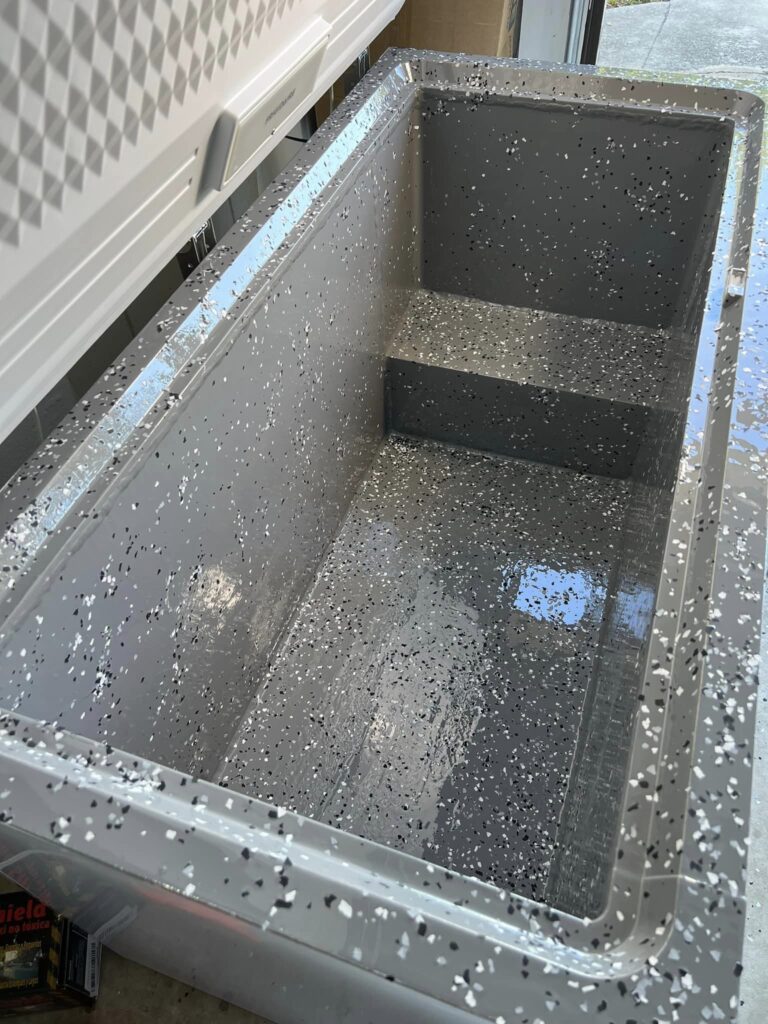
Here is how to apply them:
1. Do not add the flakes directly into Pond Shield when mixing the two parts. Part A and Part B should be mixed with NO flakes. Immediately after you apply the mixed Pond Shield to your interior, sprinkle the flakes by hand over the surface and use a roller to flatten them out.
2. There are two ways to finish the flakes. Both have reports of working. Choose one.
Option A
Wait 24 hours after the final coat to cure with the flakes. Use a wet microfiber cloth and rub off the flakes that didn’t adhere or might be poking out.
Option B
Apply a final clear coat of Pond Shield over the flakes. Follow all other best practices with regard to prep work, mixing, total number of layers, etc.
Shimicoat Note
Pond Shield is chemical-resistant and should not fade when used with chlorine, ozone, or other chemicals for sanitation.
However, if you are using Shimicoat, the company recommends that the last layer be a clear coat of chemical-resistant clear epoxy to help prevent potential issues with discoloration or fading, especially if using pool chemicals or chlorine. This is not essential, but it is a nice-to-have if you want your color to remain the same.
Fixing Exposed Trim
If you ended your Pond Shield application on the top interior wall below the trim, or only covered part of the trim, there are two solutions:
1. Apply additional Pond Shield to the trim, extending about 2-3 inches onto the existing coating. Follow the instructions in this guide for additional coats.
2. Seal the edge. Since the exposed edge is most likely above the water line, using a high-quality silicone or marine adhesive is OK. However, keep a close eye on it, and if you notice it peeling or shrinking over time, the seal may need to be redone. If you plan to use ozone, make sure that the sealant you use is compatible.
7. Let it Cure
For best long-term results, allow it to cure for 7 days before adding water. I know the Pond Shield website says it will cure in 24 – 30 hours. However, that is for regular applications, which do not typically contain water that will be quickly exposed to the extreme temperatures we use in our cold plunges.
From our community epoxy resin expert, Simonne: while the instructions say you can add water after 24 – 30 hours, this means the product has set, but it has not yet reached maximum hardness. If it has not reached maximum hardness, chemicals could leach into the water.
Moreover, there is more to a product curing than it being dry to the touch. The epoxy needs to harden completely, and many variables can affect this: temperature, humidity, how well you mixed it, how it was applied, etc.
You’ve done all of the hard work. Now is the time to be patient and give yourself the best chances of long-term success.
The best practice is to wait SEVEN full days before adding water.
Tip: Do NOT use tape, Velcro, or other adhesives to attach things (ex., phone holders) to your Pond Shield; it can damage your application.
Enjoy Your Cold Plunge!
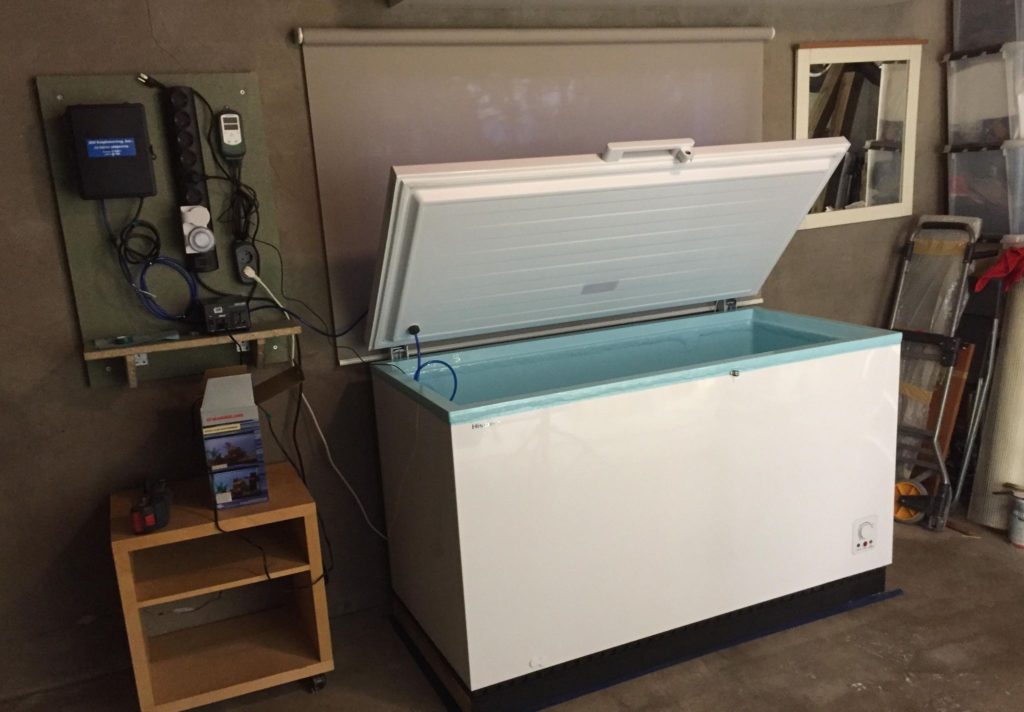
Where to Buy
You can find Pond Shield in local big box hardware stores. If you use my Amazon Affiliate Link below, it doesn’t cost you any more, and I earn a small commission that helps me support our global cold plunge community and my family.
Pond Shield
Self Etching Primer
Other Options
Pond Shield is available through Amazon and other resellers in many countries.
There are other 2-part epoxy resin products out there. If you choose to use one, make sure that it is suitable for a cold plunge, safe for you, and compatible with your chosen sanitation method.
In one of my early experiments, I spent around $400 on a 2-part pond coating epoxy resin and $400 to have it professionally applied, only to find out that it was not compatible with ozone.
Make sure that after it cures, it will not leech toxic chemicals into the water. If it is rated or certified to be safe for aquatic life or used in pools/spas, it should be fine for your cold plunge.
So far, we have received positive feedback from people in Australia using Shimicoat Swimming Pool 2-part Epoxy Resin.
Single-part resins and paints are not suitable.
Troubleshooting
Lumps in Your Resin
A few things can cause lumps in new, non-expired epoxy resin. If you find lumps in your next batch, here’s what to do.
Put the can in water that is around 120°F (49°C) for 20-30 minutes. Stir it with a clean stir stick to break up the lumps and make sure it is evenly mixed.
If that doesn’t fix the problem, contact the manufacturer or retailer for a replacement.
Imperfections
If you have imperfections in your coat, let it dry completely. Use a fine-grit (220) sandpaper to remove the imperfection without removing the layers (if any) below. If it is a small area, use painter’s tape to mask off the area that needs work.
Vacuum the dust, wipe the area with acetone (not too much), let it dry, and apply another coat.
Sticky or Tacky Surface
If your surface feels sticky, it has most likely not cured because of an incorrect mixing ratio, inadequate mixing, or unsuitable temperature or humidity.
If the area is small, mask it off with painter’s tape, about a 1-inch away from the affected spot.
Remove the sticky layer with sanding or acetone if needed. Clean and dry.
Reapply new Pond Shield, ensuring that you mix thoroughly and that the environmental conditions are favorable.
Bubbles
Trapped air during mixing or applying too thick a layer can cause bubbles.
Use a heat gun or torch to pop the bubbles. For smaller projects, use a toothpick to release surface bubbles. Pouring in thinner layers and mixing more slowly can help prevent this problem.
Cracking
Pouring too thick a mixture or curing too quickly because the temperature is too hot can result in cracking.
Sand the cracked area and fill it with a new thin layer. Work in an area within the recommended temperature range.
Delamination/Peeling
A number of variables can cause your Pond Shield to peel off from the surface
- If the surface was not cleaned properly or was contaminated by dust, oils, or sweat, it could peel.
- Not using self-etching primer on bare metal.
- Not roughing up the entire surface or not using heavy-grit sandpaper.
- Applying a new coating on a tacky or uncured layer
- High humidity, low temperatures, or temperature fluctuations during curing
- Incorrect mixing ratio
- Inadequate mixing
If your Pond Shield peels off, remove all loose material with sanding or acetone. Follow best practices to reapply. If you did not correctly prepare the surface, it is best to remove 100% of the Pond Shield and start over.
Repairs
If you have a small section of pond shield that has been damaged, or is peeling, bubbling, or otherwise not intact, you don’t need to redo the entire application, just the affected area.
- Completely remove the damaged Pond Shield with 60-80 grit sandpaper.
- Place masking tape (for best results, use the kind meant for epoxy resin) so that you have about 4-5 inches of “good” pond shield surrounding the damaged area.
- Lightly sand the good application, feathering out from the damaged area. Do your best to prevent a hard edge from the good area to the bad area that has been removed.
- Follow the rest of the best practice instructions above, adding 3-4 coats of new Pond Shield.